Showing Posts From
Ukiyo e
-
Sleepy Tales of Japan - 22 Apr, 2026
Life in Edo: What the World's Largest City Was Really Like
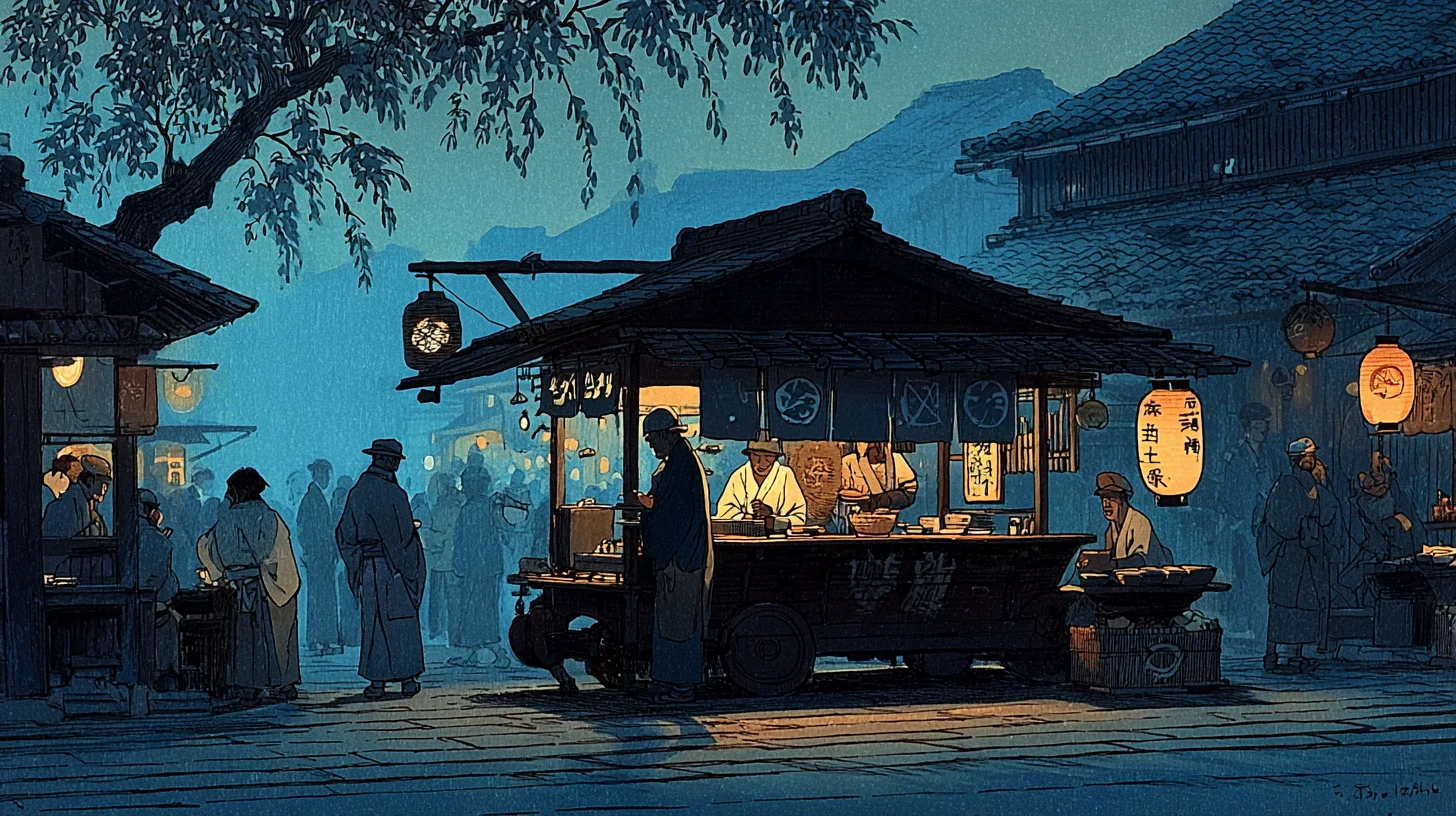
Picture an evening in Edo, sometime around the year 1700. The sun has just set, and the city is not getting quieter — it is waking up. Lanterns appear along the streets in long lines of amber and white. The smell of charcoal and soy sauce drifts from food stalls lining the canal banks. Somewhere nearby, the sharp notes of a shamisen — a three-stringed instrument — hang in the evening air, each note lingering before the next one falls. Over one million people live here. More than in London. More than in Paris. More than in any city the world has ever known. This is not a capital of emperors or kings. This is a city built by, and for, ordinary people — and their story is unlike anything in the history of the world.💡 This article explores the history behind our sleep story episode. Watch on YouTube: Tokyo — A City Born from SwamplandTable of ContentsA City of Fire and Reinvention The Economy of a Million The Floating World A Bowl of Soba, a Woodblock Print The Closed Country That Opened Inward What Edo Left Behind FAQA City of Fire and Reinvention Edo was built almost entirely of wood. Paper screens. Thatched and shingled roofs. Charcoal braziers for warmth. In a city this dense, fire was not a question of if but when. On March 2, 1657, the Meireki Fire broke out. Over the next three days, wind-driven flames consumed an estimated 60 to 70 percent of the city. By some accounts, over 350 temples and shrines burned, along with more than 160 daimyō residences — the mansions of feudal lords. The main keep of Edo Castle, which had risen over 40 meters tall, was reduced to ash. The fire is estimated to have killed over 100,000 people, though the exact toll remains uncertain. The castle keep was never rebuilt. The shogunate declared it a wasteful symbol and redirected funds toward the city itself. What followed was one of the earliest examples of deliberate urban planning after a disaster. Streets were widened. Firebreaks — open spaces designed to halt the spread of flames — were created throughout the city. Temples and shrines that had crowded the urban center were relocated to the outskirts, freeing space for roads and evacuation routes. New building regulations encouraged the use of earthen walls and tile roofing in commercial districts. Edo would burn again — hundreds of times over the next two centuries. The residents came to speak of fires as "the flowers of Edo" (Edo no hana), a dark proverb born from bitter familiarity. But each time, the city rebuilt. Each time, it grew back a little differently — a little smarter, a little more resilient.The Economy of a Million How do you feed, clothe, and house a million people in a pre-industrial city? The answer lay in a system that was both political control and economic engine: sankin-kōtai, the alternate attendance system. As described in our previous article, every feudal lord in Japan was required to spend alternating years in Edo. Their families remained in the capital permanently. The constant travel and maintenance of dual residences consumed a significant share of a lord's income — some historians estimate the system accounted for the majority of a domain's total expenditures — leaving little surplus for building armies or mounting challenges to the shogunate. But the system had an unintended consequence: it made Edo rich. Hundreds of lords, each with hundreds or thousands of retainers, needed food, lodging, clothing, entertainment, and supplies. This created a permanent consumer economy in the capital. Rice brokers, sake merchants, textile dealers, and carpenters thrived. A merchant class — officially the lowest rung of the social hierarchy — quietly became the wealthiest group in the city. Edo's commercial districts hummed with activity. Nihonbashi, the bridge that marked the starting point of the Five Highways, was also the center of commerce. Fish markets operated at its base from dawn. Kimono shops, publishing houses, and money changers lined the surrounding streets. The chōnin — the townspeople — built a world that the samurai depended on but could never fully control.The Floating World The chōnin did more than trade. They created a culture. The term ukiyo — "the floating world" — had once been a Buddhist word meaning the sorrowful, transient world. But in Edo, the townspeople reclaimed it. They kept the kanji for "floating" but stripped away the sorrow. The floating world became the world of pleasure, beauty, and the present moment — a world worth savoring precisely because it would not last. Kabuki theater was at its heart. Born in Kyoto around 1603, kabuki evolved into Edo's defining art form during the Genroku era of the late 1600s. Performances combined drama, dance, and spectacle — with innovations that Europe would not see for another century, including a revolving stage and the hanamichi, a raised walkway extending into the audience. Then there were the prints. Woodblock artists carved images into cherry wood blocks, inked them, and pressed them onto paper — one color at a time, sometimes ten or more layers for a single image. The resulting nishiki-e (brocade pictures) depicted actors, courtesans, landscapes, and scenes from daily life. A single full-color print cost roughly 16 mon — about the same as a bowl of soba noodles. Art, for the first time, belonged not to temples or lords but to everyone who could spare the price of lunch. The poets walked here too. Matsuo Bashō, the most celebrated haiku poet in Japanese history, lived in Edo and wandered its surrounding countryside. His most famous verse — a frog leaping into an old pond, the sound of water — captured something the floating world understood instinctively: beauty lives in the ordinary, and the ordinary is never as simple as it seems.A Bowl of Soba, a Woodblock Print If Edo's high culture was the floating world, its everyday culture was the street. Edo was a city of yatai — portable food stalls that lined the busiest streets and canal banks. After the Meireki Fire of 1657, as the city rebuilt and eating-out culture surged among displaced residents, street food became central to daily life. Soba noodles — buckwheat noodles served in hot broth or cold with a dipping sauce — were the fast food of Edo. Quick, cheap, and satisfying, they were the meal of choice for workers, merchants, and samurai alike. Tempura, originally influenced by Portuguese cooking techniques, spread as cooking oil became cheaper through the mid-Edo period. Vendors fried vegetables and shrimp in light batter and served them on skewers. And in the late Edo period, a stall owner named Hanaya Yohei is credited with popularizing nigiri-zushi — hand-pressed vinegared rice topped with fresh fish from Edo Bay — as a fast, affordable meal sold from stalls in the Ryōgoku district. Beyond food, Edo's daily life revolved around communal spaces. The sentō — public bathhouses — served as neighborhood gathering places. Edo's earliest bathhouses date to the 1590s, and by the height of the Edo period, hundreds operated across the city. Most commoners had no private bathing facilities, so the bathhouse was where neighbors met, gossip traveled, and the day's tensions dissolved in steam. And then there were the books. Edo was, by the standards of its time, extraordinarily literate. Scholars estimate that 70 to 80 percent of urban commoners in Edo could read — a figure that, if accurate, far exceeded contemporary London or Paris. By some estimates, over a thousand terakoya (temple schools) operated in the city, teaching reading, writing, and arithmetic to children of merchants and artisans. A thriving publishing industry produced novels, travel guides, satirical works, and illustrated books that circulated through lending libraries, making literature accessible even to those who could not afford to buy.The Closed Country That Opened Inward From the 1630s onward, the Tokugawa shogunate enacted a series of edicts that would come to be known as sakoku — the closed country policy. Japanese subjects were forbidden to travel abroad from 1633. Portuguese traders, suspected of spreading Christianity, were expelled in 1639. By 1641, foreign trade was restricted almost entirely to a single artificial island in Nagasaki harbor: Dejima, where Dutch merchants lived under strict surveillance. But Japan was never entirely sealed. Chinese merchants traded at Nagasaki. Korea maintained diplomatic relations through the Tsushima domain. The Ryūkyū Kingdom (modern Okinawa) traded via the Satsuma domain in the south, and Ainu trade continued through Matsumae in the north. What sakoku did seal, however, was the cultural direction of the country. Cut off from the constant influx of foreign ideas that shaped European nations during the same period, Japan turned inward — and in doing so, created something remarkable. Without foreign wars to fight, without colonial ambitions to pursue, the energy of the country flowed into craft, art, and refinement. Ceramics, lacquerwork, textile dyeing, metalwork, garden design, tea ceremony, flower arrangement — each discipline deepened over generations, passed from master to apprentice in unbroken lines. The roughly 250 years of relative peace under the Tokugawa — one of the longest sustained periods of peace in the history of any major nation — became an incubator for a culture of extraordinary depth and detail. This is the paradox of sakoku: a policy designed to control produced a society that created.What Edo Left Behind Stand at the edge of the Imperial Palace moat in central Tokyo today. The water is dark and still. The stone walls that line it — massive, fitted without mortar — were placed there in the early 1600s. The castle keep is gone, burned in 1657 and never rebuilt. But the moats remain, tracing the same spiral pattern that Tokugawa Ieyasu's engineers designed over four centuries ago. Walk south to Nihonbashi. The current stone bridge dates to 1911, and a highway overpass now runs directly above it — a famously ungraceful piece of modern infrastructure. But the crossing is still the crossing. The same spot where the Five Highways once began. The distance markers on every major road in Japan are still measured from this point. Continue east to Asakusa. The great red lantern of Sensō-ji still glows at the entrance to Nakamise-dōri, a shopping street that has served visitors since the Edo period. Incense smoke still drifts in slow spirals above the temple grounds. The crowds have changed — tourists with cameras instead of pilgrims with prayer beads — but the rhythm of the place feels older than any single generation. Tokyo's expressways follow the paths of filled-in canals. Its railway lines trace the outer moat. The grid of its commercial districts overlays the merchant quarters of 300 years ago. Beneath the glass and concrete of the world's largest metropolitan area — home to nearly 40 million people — the bones of Edo are still there, shaping the city the way a riverbed shapes the water that flows above it. The swamp is long gone. But the city it became is still becoming.FAQ What was daily life like in Edo? Daily life in Edo revolved around work, communal spaces, and street culture. Commoners ate at yatai food stalls, bathed at public sentō bathhouses, attended kabuki performances, and read books borrowed from lending libraries. The city had an estimated literacy rate of 70-80% among urban commoners, higher than contemporary European capitals. Why was Edo the largest city in the world? The sankin-kōtai (alternate attendance) system required all feudal lords to maintain residences in Edo and spend alternating years there with large retinues. This created a permanent population of samurai, servants, merchants, and service workers. By the early 1700s, the city's population exceeded one million. What is the "floating world" in Japanese culture? The ukiyo (floating world) refers to the urban culture of pleasure, entertainment, and art that flourished in Edo-period cities. Originally a Buddhist term meaning "the sorrowful world," it was reinterpreted by Edo townspeople to mean a world of beauty and enjoyment to be savored in the present moment. It encompassed kabuki theater, woodblock prints (ukiyo-e), literature, and the entertainment districts. How often did Edo burn? Major fires struck Edo regularly throughout the Edo period. The most devastating was the Meireki Fire of 1657, which destroyed 60-70% of the city. Fires were so common that residents called them "the flowers of Edo" (Edo no hana). The city's largely wooden construction and dense layout made it vulnerable, though post-fire urban planning gradually improved firebreaks and building practices. What traces of Edo remain in modern Tokyo? The Imperial Palace moats and stone walls date from the early 1600s. Nihonbashi bridge, though rebuilt in stone in 1911, still marks the point from which all road distances in Japan are measured. Sensō-ji in Asakusa preserves the atmosphere of an Edo-period pilgrimage site. Many of Tokyo's expressways follow filled-in canals, and railway lines trace the outer moat system.SourcesTokyo: History — Encyclopedia Britannica Sankin-kōtai — Encyclopedia Britannica Kabuki — Encyclopedia Britannica Sakoku — Encyclopedia Britannica Japan, 1600–1800 A.D. — The Metropolitan Museum of Art Meireki Fire — Edo-Tokyo Digital Museum Nishiki-e Defined — Hoover Institution, Stanford University Sento: History of Japan's Bathhouse Culture — Nippon.com Terakoya: The Temple Schools of Edo-Period Japan — Nippon.com