Is Mount Fuji Still an Active Volcano? Yes — Here's What Happened in 1707, and What Scientists Are Watching For Next
- Sleepy Tales of Japan
- 15 min read
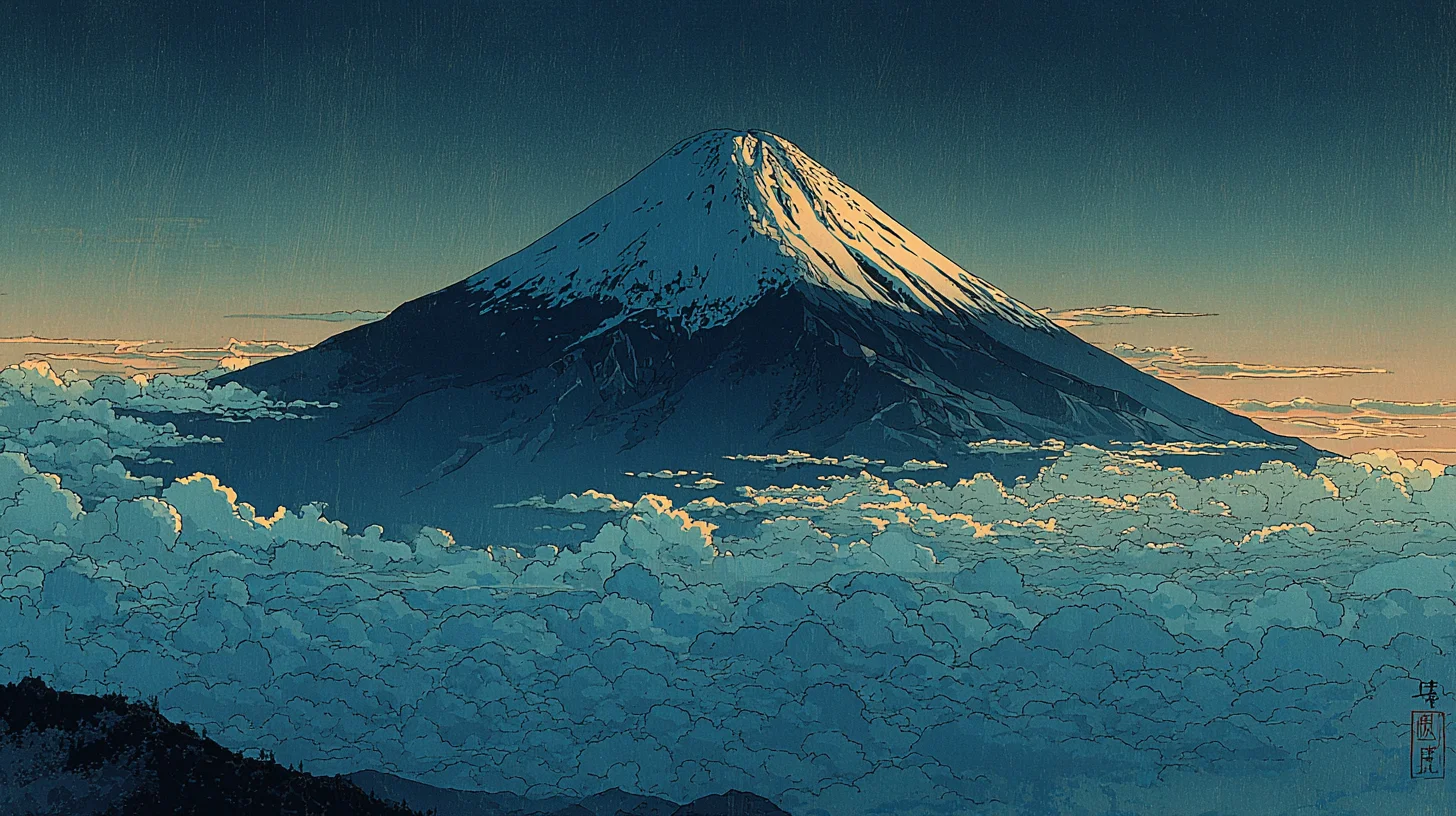
If you take the bullet train from Tokyo to Kyoto, there’s a moment — roughly fifty minutes in, on the right side of the car — when Mount Fuji fills the window. It looks almost too perfect. A single, symmetrical cone, snow-capped, floating above the clouds. But that perfect shape is a lie — or at least a simplification. Fuji is not one volcano. It is three, stacked on top of each other over 2.6 million years. It is officially classified as an active volcano by Japan’s Meteorological Agency. And it last erupted just 318 years ago, in 1707, when ash fell on the streets of Edo — the city we now call Tokyo — for sixteen straight days.
Table of Contents
Open Table of Contents
Three Volcanoes, One Mountain
The mountain you see from the Shinkansen window is the youngest of three. Beneath the smooth modern slopes of Fuji lie the remains of two older volcanoes, buried under centuries of lava and ash like layers in a geological wedding cake.
The oldest, called Komitake, began forming roughly 2.6 million years ago. It was a modest peak — nothing like the towering icon we know today. Over hundreds of thousands of years, a second volcano grew on top of it: Ko Fuji, or “Old Fuji.” Ko Fuji was larger, more violent, and prone to explosive eruptions that reshaped the surrounding landscape again and again.
Then, roughly 10,000 years ago, the youngest layer began to build. This is Shin Fuji — “New Fuji” — and it is the smooth, symmetrical cone that appears on postcards and currency. Shin Fuji gradually buried the rough edges of its predecessors, creating the illusion of a single, perfect mountain. But the older volcanoes are still there, hidden beneath the surface, detectable only through geological surveys and the occasional outcrop on Fuji’s northern slopes.
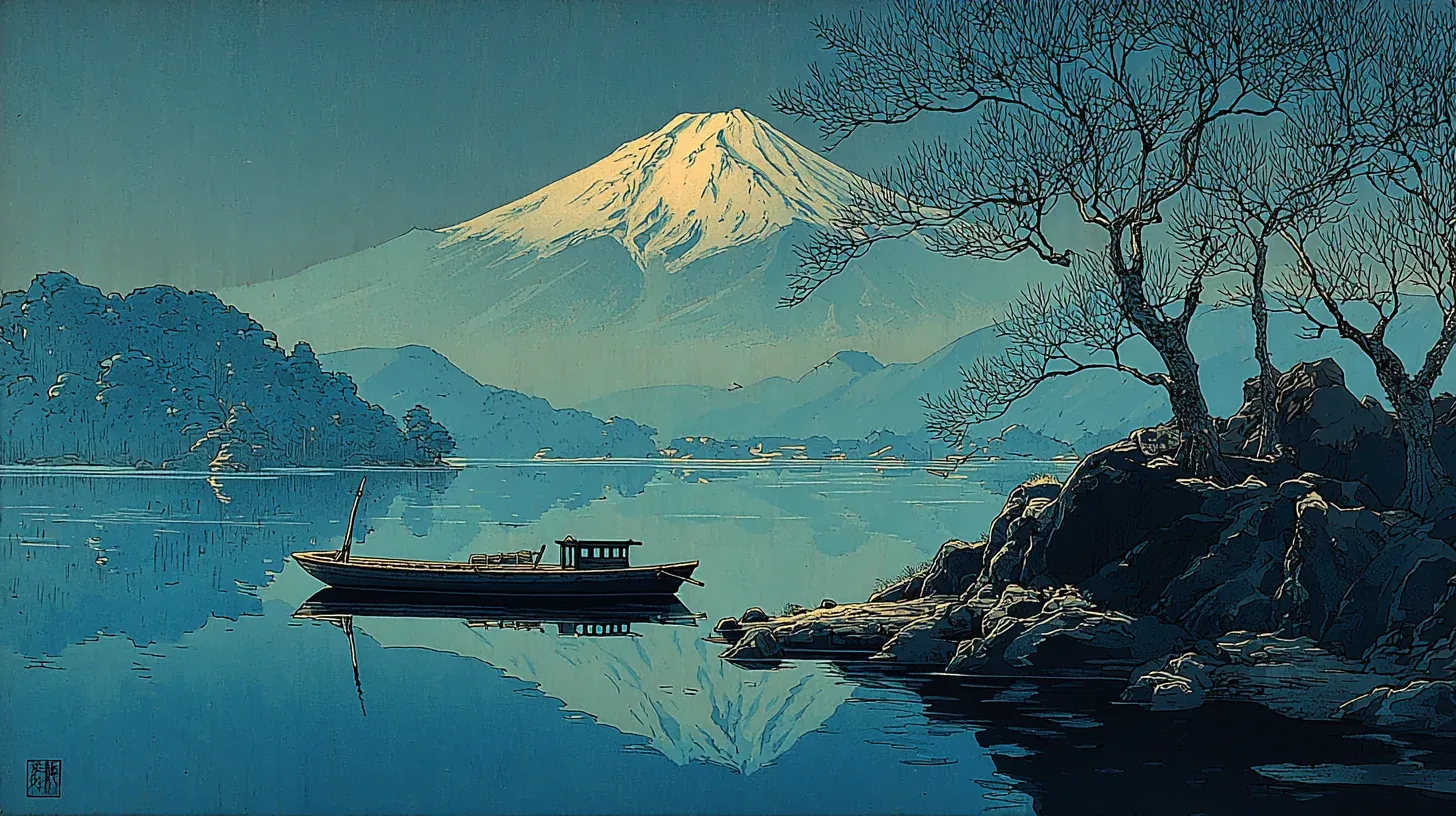
Fuji has erupted at least 18 times in recorded history. One of the most significant was the Jōgan eruption of 864, which sent massive lava flows pouring down the northern slopes and into a large lake called Senoumi. The lava divided the lake into smaller bodies of water, creating what are known today as the Fuji Five Lakes — Kawaguchiko, Yamanakako, Saiko, Shōjiko, and Motosuko. These lakes, which draw millions of visitors each year, exist because a volcano tore apart an older, forgotten body of water over a thousand years ago.
Standing at 3,776 meters, Fuji is Japan’s tallest peak. It sits at the junction of three tectonic plates — the Eurasian, Philippine Sea, and North American plates — a geological position that explains both its existence and its unpredictability. The mountain is classified as an active volcano. It is not a question of whether Fuji will erupt again, but when.
The Goddess in the Fire
Long before geologists mapped its layers, the Japanese people understood Fuji as sacred. In Shinto mythology, the mountain is the dwelling place of a goddess called Konohanasakuya-hime — the “Princess Who Makes the Trees Bloom.”
Her story is one of fire and faithfulness. According to the ancient chronicles, Konohanasakuya-hime married the god Ninigi-no-Mikoto, grandson of the sun goddess Amaterasu. When she became pregnant after only one night, Ninigi doubted the child was his. To prove her fidelity, Konohanasakuya-hime sealed herself inside a birthing hut and set it ablaze. She emerged unharmed, carrying three healthy sons. The fire could not touch her because her loyalty was absolute.
This story tied the goddess to fire, and fire to the mountain. Konohanasakuya-hime became the deity of Mount Fuji — a protector who calms the volcano’s flames. Her presence is honored at a network of Shinto shrines called Sengen shrines, of which roughly 1,300 exist across Japan.
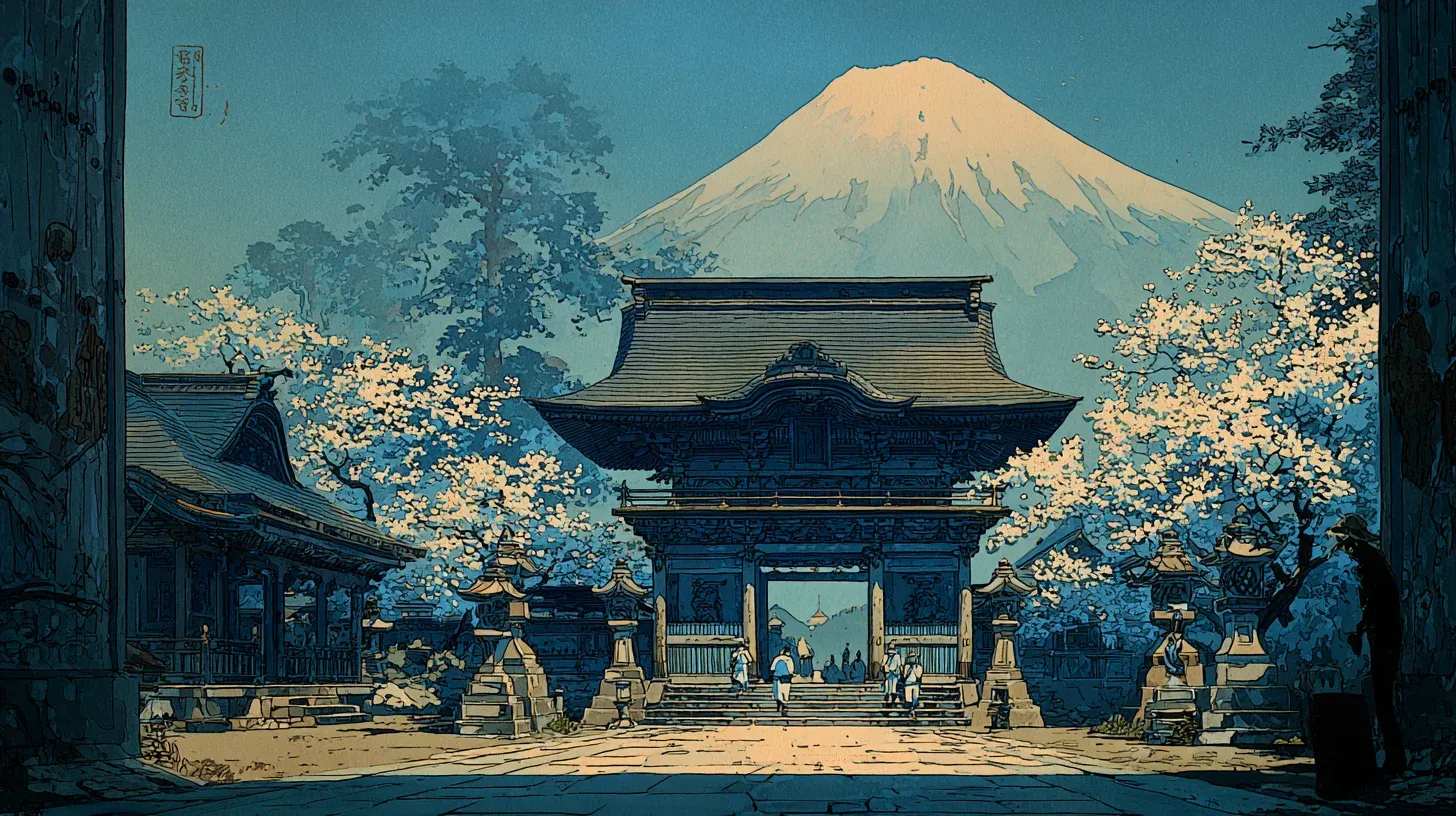
The most important of these is Fujisan Hongu Sengen Taisha in the city of Fujinomiya, at Fuji’s southwestern base. The shrine was founded in 806 by Sakanoue no Tamuramaro, one of the most celebrated military commanders of the early Heian period. Tamuramaro established the shrine to appease the mountain after a series of eruptions, believing that proper worship of Konohanasakuya-hime would calm Fuji’s fury.
The shrine’s significance only grew over the centuries. After his victory at the Battle of Sekigahara in 1600, Tokugawa Ieyasu became the effective ruler of Japan. He devoted considerable resources to rebuilding and expanding the shrine, recognizing its spiritual importance as a tool of political legitimacy. The main hall and the two-story tower gate that survive today date from this early Edo-period reconstruction.
Here is a detail that surprises many visitors: the summit of Mount Fuji is not public land. Everything above the eighth station — roughly 3,250 meters — is legally the grounds of Fujisan Hongu Sengen Taisha. When climbers reach the top, they are standing on shrine property. The mountain’s peak belongs not to the government, but to a goddess.
When Ordinary People Built Their Own Fuji
For most of Japan’s history, climbing Mount Fuji was a religious act. It was not recreation or exercise. It was pilgrimage. And for centuries, it was reserved almost exclusively for men.
This began to change in the Edo period (1603-1868), when a religious movement called Fujikō transformed the mountain from an elite pilgrimage site into a popular obsession. The key figure was a practitioner named Hasegawa Kakugyō, who lived from 1541 to 1646 by some accounts — an extraordinarily long life that itself became part of his legend. Hasegawa systematized the worship of Mount Fuji, blending Shinto and Buddhist practices into a set of rituals that ordinary people could follow.
The Fujikō movement spread rapidly through Edo — the city we now call Tokyo. Neighborhood associations formed clubs, pooling money so that a few representatives could make the pilgrimage to Fuji’s summit on behalf of the entire group. Members who stayed behind would gather to pray and celebrate as their delegates climbed. It was a communal act of faith, organized from the bottom up by merchants, craftsmen, and laborers who had no access to the aristocratic pilgrimages of earlier centuries.
But there was a problem. Women were banned from climbing Mount Fuji. The prohibition was rooted in Buddhist beliefs about ritual impurity, and it would not be formally lifted until 1872, after the Meiji government’s separation of Shinto and Buddhism. Elderly people and children also found the climb impossible. The mountain was sacred, but it was not accessible to everyone.
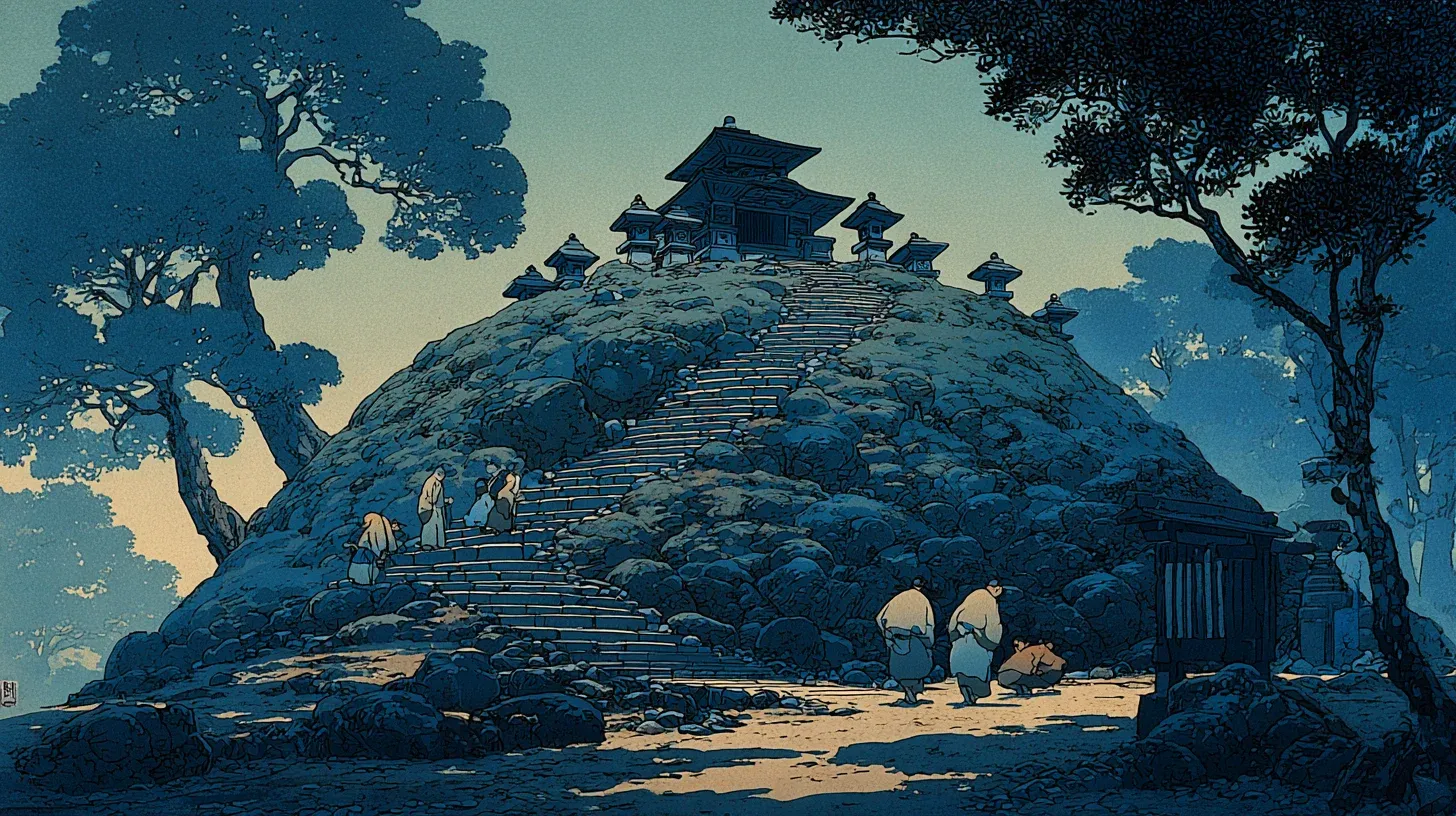
The solution was inventive. Across Edo, communities built miniature replicas of Mount Fuji called Fuji-zuka — artificial mounds, typically three to ten meters tall, constructed from volcanic rock actually transported from Mount Fuji itself. A path wound around each mound, passing small shrines and markers that corresponded to the stations on the real mountain. By climbing a Fuji-zuka, a person could symbolically complete the pilgrimage without ever leaving the city.
At their peak, by some accounts roughly 800 Fuji-zuka existed in Edo alone. They appeared in shrine grounds, on empty lots, and in neighborhood parks. Some were simple piles of rock. Others were elaborate constructions with miniature caves, waterfalls, and planted trees.
Most have been demolished over the centuries as Tokyo grew and land became valuable. But a handful survive. You can still climb a Fuji-zuka at Hatonomori Hachiman Shrine in Sendagaya or at Shinagawa Shrine — a pocket-sized pilgrimage in the middle of one of the world’s largest cities.
The Day Ash Fell on Edo
On the morning of December 16, 1707, Mount Fuji erupted. It was the most powerful eruption in the mountain’s recorded history — a VEI 5 event, the same scale as Mount St. Helens in 1980. The eruption would last for roughly two weeks and reshape life across the Kanto region for a decade.
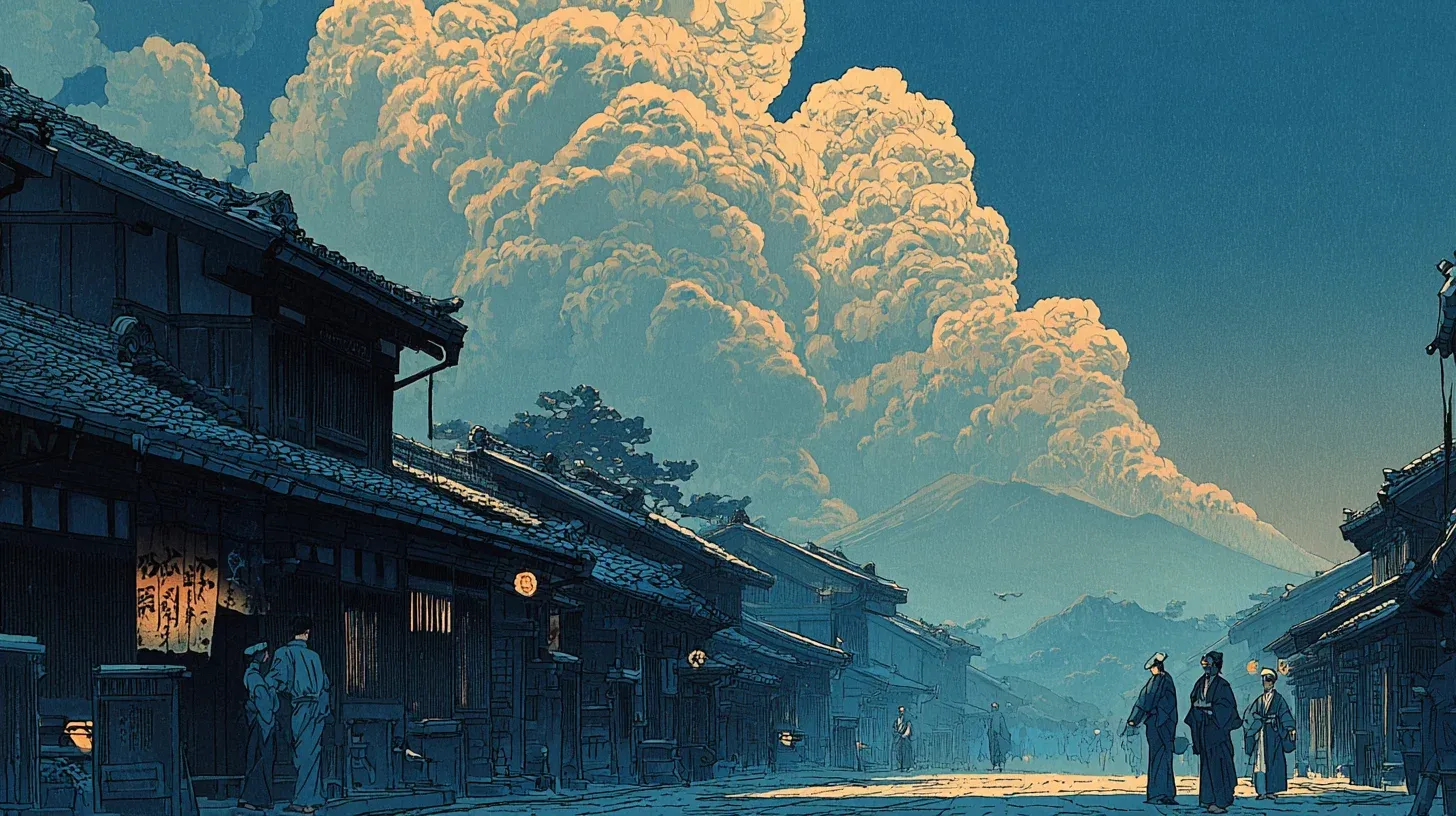
What made this eruption particularly devastating was not lava but ash. A massive column of volcanic debris rose into the sky and, carried by prevailing winds, drifted southeast toward Edo, roughly 100 kilometers away. By midday, the sky over the capital had turned dark. Ash fell like grey snow, piling up on rooftops, filling wells, and choking rice paddies. Some accounts describe ash accumulating to several centimeters deep in the streets of Edo.
The eruption created a new crater on Fuji’s southeastern slope — the Hōei-zan crater, named after the era in which it occurred. It is still clearly visible today, a conspicuous scar on an otherwise symmetrical mountain. If you look at Fuji from Tokyo or from the Shinkansen, the Hōei-zan crater is the bump on the right side of the slope.
The agricultural damage was catastrophic. Ash buried farmland across what is now Kanagawa and Shizuoka Prefectures. Rivers clogged with volcanic debris flooded repeatedly. Crop failures led to roughly a decade of famine in the affected regions, and the economic recovery took even longer. The Tokugawa government struggled to fund relief efforts, diverting resources from other projects and imposing special taxes on domains across Japan.
What makes the Hōei eruption even more alarming in retrospect is its timing. Just 49 days before Fuji erupted, on October 28, 1707, the Hōei earthquake struck — one of the most powerful earthquakes in Japanese history, estimated at magnitude 8.6. The quake devastated large sections of the Pacific coast, generating massive tsunamis that killed thousands.
Scientists today believe the earthquake may have triggered the eruption by destabilizing the magma chamber beneath Fuji. The connection between the two events remains a subject of ongoing research, but the proximity is difficult to dismiss as coincidence. For modern disaster planners, the Hōei sequence is a sobering reminder: a major earthquake and a major eruption can arrive together, compounding their destruction.
Mount Fuji has not erupted since 1707. That is 318 years of silence — the longest quiet period in its recorded history. The mountain is constantly monitored by the Japan Meteorological Agency, and evacuation plans are regularly updated.
But the silence is not reassurance. It is a pause.
The Mountain That Became an Icon
Before photography, before tourism, before the bullet train — Fuji was already the most recognizable mountain in the world. That fame belongs largely to one artist: Katsushika Hokusai.
In 1831, when Hokusai was roughly 70 years old, he published a series of woodblock prints called “Thirty-six Views of Mount Fuji.” Despite the title, the series eventually grew to 46 prints. Each one depicted Fuji from a different location and perspective — from fishing boats, rice paddies, barrel-makers’ workshops, and the crests of enormous waves.
Two prints from the series became global icons. “The Great Wave off Kanagawa” shows a towering wave about to crash over small fishing boats, with Fuji sitting tiny and still in the background. It is one of the most reproduced images in the history of art. The second, “Fine Wind, Clear Morning” — commonly called “Red Fuji” — captures the mountain at dawn, its slopes glowing a deep reddish-brown under a sky streaked with cirrus clouds. Together, these prints introduced Fuji to audiences far beyond Japan and influenced European Impressionists including Claude Monet and Edgar Degas.
Hokusai was not the only artist who built his reputation around the mountain. Utagawa Hiroshige, his contemporary, painted Fuji repeatedly in his travel landscape series, particularly “The Fifty-three Stations of the Tōkaidō.” Where Hokusai’s Fuji was bold and graphic, Hiroshige’s was atmospheric — wrapped in rain, mist, and the soft light of dusk.
A century later, in the early twentieth century, the artist Kawase Hasui carried the tradition forward in the shin-hanga (“new print”) movement. Hasui’s depictions of Fuji — viewed across lakes at dawn, through snow-covered trees, from quiet rural roads — brought a modern sensibility to a centuries-old subject. His prints emphasized stillness and solitude, presenting Fuji not as a symbol of power but as a presence felt in silence.
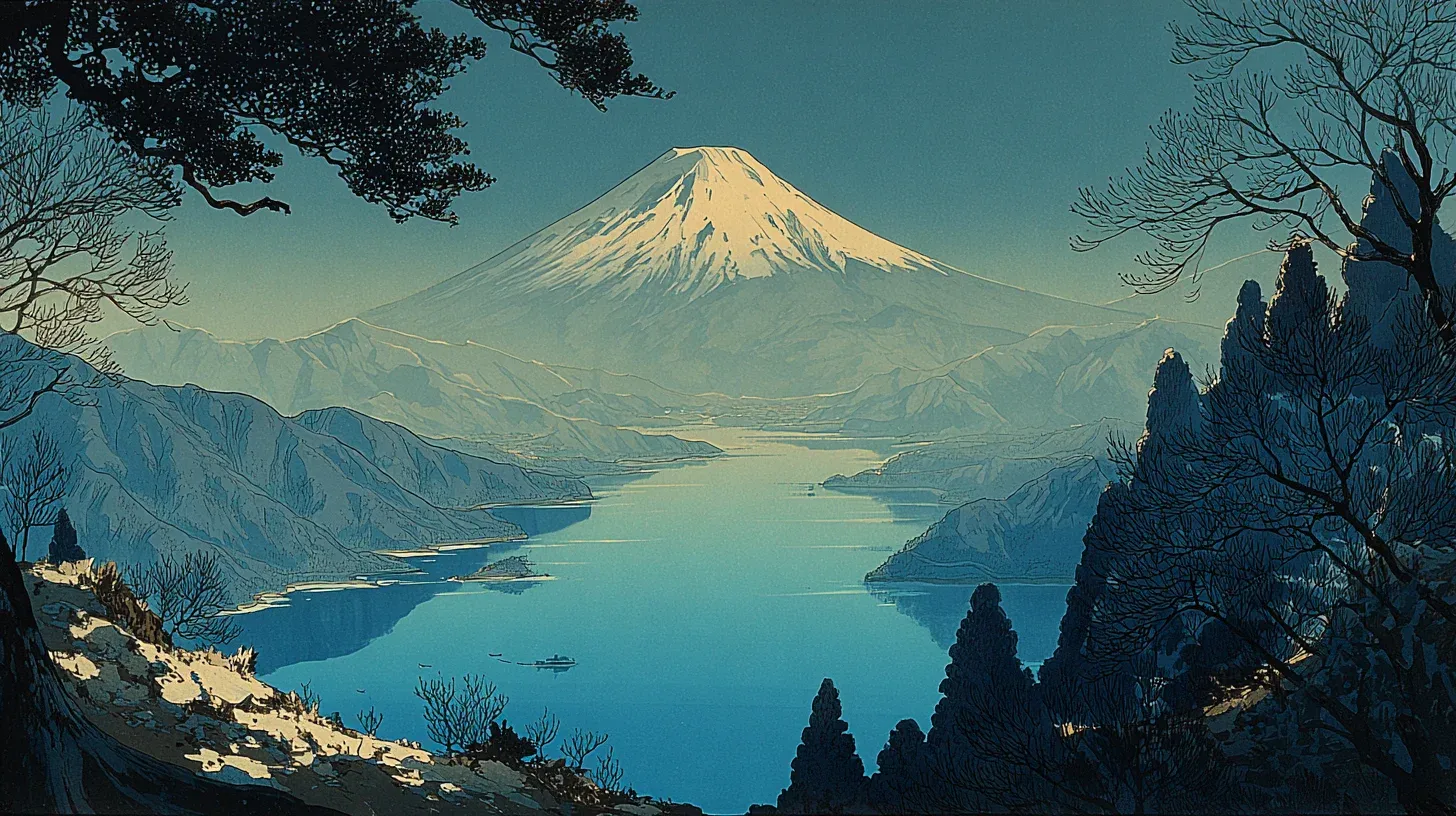
The mountain’s image eventually made its way onto currency. The photograph on the reverse of the Japanese 1,000-yen bill — used from 1984 to 2024 — was taken at Lake Motosu by the photographer Okada Kōyō in 1935. The image shows Fuji reflected perfectly in the lake’s still water, framed by bare winter trees. Lake Motosu, the deepest and clearest of the Fuji Five Lakes, remains one of the most popular spots for visitors hoping to recreate this view.
From Hokusai’s woodblocks to Okada’s photograph, Fuji has been captured more times than any other mountain on Earth. And yet it never quite looks the same twice. The mountain changes with the light, the season, the weather, and the angle of the viewer. That inexhaustibility is part of what makes it sacred — not just to Shinto, but to the human eye.
Climbing Fuji Today
There is a Japanese proverb that says: “A wise person climbs Fuji once. A fool climbs it twice.” The saying captures something real. The climb is not technically difficult, but it is long, exhausting, and often cold. And for most people, once is enough.
Modern climbing on Mount Fuji begins at the 5th station, roughly 2,300 meters above sea level. From there, four routes lead to the summit at 3,776 meters. The most popular is the Yoshida Trail, which starts on the mountain’s northern side and accounts for more than half of all climbers. The other three routes — Subashiri, Gotemba, and Fujinomiya — are quieter but steeper or longer.
The official climbing season runs from early July to mid-September only. Outside this window, the mountain huts are closed, the trails are unmaintained, and conditions can turn dangerous without warning. Winter climbing is attempted by experienced mountaineers but is not recommended or supported.
Starting in 2024, and continuing into 2025 and beyond, the mountain introduced significant access controls. A mandatory entry fee of 4,000 yen (roughly $27 USD) applies to all climbers on the Yoshida Trail, and a gate system limits the number of climbers per day. Visitors must register in advance through a smartphone application for the Shizuoka-side routes (Subashiri, Gotemba, and Fujinomiya). These measures were introduced in response to years of overcrowding that had turned the trails into something resembling a queue at a theme park during peak season.
The environmental challenges on Fuji are real. There are no trash cans above the 5th station. Climbers are expected to carry all waste back down with them. Human waste management at the mountain huts has been an ongoing concern, and the cost of maintaining composting toilet systems at high altitude is substantial. The trails themselves show visible erosion from decades of heavy foot traffic.
These environmental issues played a direct role in Fuji’s UNESCO designation. When Japan first proposed Fuji for World Heritage status, the application targeted the Natural Heritage category. However, the environmental degradation of the mountain — litter, erosion, waste management problems — made this classification difficult to justify. The application was revised, and in 2013, Mount Fuji was inscribed as a UNESCO World Cultural Heritage site, recognized not for its pristine natural condition but for its profound influence on Japanese art, religion, and culture.
The distinction matters. Fuji earned its place on the World Heritage list not because it is an untouched wilderness, but because it is a mountain that has shaped a civilization. The goddess, the pilgrims, the prints, the ash, and the climbers — they are all part of the same story.
Next time you see Fuji from the right side of the Shinkansen window, you’ll know what you’re looking at. Not a single mountain, but three, built one on top of another over millions of years. Not a dormant landmark, but an active volcano in its longest quiet period in recorded history. Not just a shape against the sky, but a shrine, a canvas, a pilgrimage, and a warning — all at once.
The train will pass, and Fuji will slip behind you. But the mountain isn’t going anywhere. It has been waiting for 2.6 million years. It can wait a little longer.
Continue Reading
- Mount Fuji: The Complete Guide — the practical hub article on visiting Fuji.
- Mount Fuji’s Five Lakes — the lakes carved out by Fuji’s own eruptions.
- Chureito Pagoda: The Most Photographed View — the war memorial that frames the volcano.
- Mount Fuji in Art: 300 Years of an Obsession — Hokusai, Hiroshige, and Hasui’s mountain.
FAQ
Is Mount Fuji an active volcano?
Yes. The Japan Meteorological Agency classifies Mount Fuji as an active volcano with a volcanic alert level. It last erupted in 1707 during the Hōei eruption, which deposited ash across Edo (modern-day Tokyo), roughly 100 kilometers away. Fuji sits at the junction of three tectonic plates — the Eurasian, Philippine Sea, and North American — making it one of the most closely monitored volcanoes in Japan. A government hazard map published in 2021 estimates that a Hōei-scale eruption today could affect transportation and infrastructure across the greater Tokyo area.
How many times has Mount Fuji erupted?
Mount Fuji has erupted at least 18 times in recorded history. Major eruptions include the Jōgan eruption of 864, which sent massive lava flows down the northern slopes and created the Fuji Five Lakes, and the Hōei eruption of 1707, the most recent, which sent ash as far as Edo. Multiple eruptions also occurred during the Heian period (794–1185). The mountain has been quiet for over 300 years — its longest dormant period on record.
Can you climb Mount Fuji?
Yes, during the official climbing season from early July to mid-September. There are four routes from the 5th station to the summit. A mandatory entry fee of 4,000 yen applies, and advance registration is required for certain routes. The climb typically takes 5 to 7 hours up and 3 to 4 hours down.
Why is Mount Fuji sacred?
Mount Fuji is considered the home of the Shinto goddess Konohanasakuya-hime, the “Princess Who Makes the Trees Bloom.” Roughly 1,300 Sengen shrines across Japan are dedicated to her worship. Everything above the 8th station of the mountain is legally the grounds of Fujisan Hongu Sengen Taisha. The Fujikō pilgrimage tradition, which flourished during the Edo period, further cemented the mountain’s spiritual significance.
What is a Fuji-zuka?
A Fuji-zuka is a miniature replica of Mount Fuji, typically built from volcanic rock in Edo-period shrine grounds. They allowed women, elderly people, and children — who were barred from or unable to make the actual climb — to complete a symbolic pilgrimage. By some accounts, roughly 800 Fuji-zuka existed in Edo (modern-day Tokyo) at their peak. A handful still survive in Tokyo today.
Where is the best view of Mount Fuji?
Several locations are famous for Fuji views. Lake Kawaguchiko offers the “inverted Fuji” reflection on calm mornings, especially from November through February. Chureito Pagoda in Fujiyoshida provides the iconic photograph of Fuji framed by a five-story pagoda and cherry blossoms. The Shinkansen right-side window seat offers a dramatic view roughly 50 minutes after departing Tokyo. Lake Motosu is where the photograph used on the 1,000-yen bill was taken.
Sources
- Mount Fuji - World History Encyclopedia
- Mount Fuji - Britannica
- Fujisan - UNESCO World Heritage Centre
- Last Eruption of Mount Fuji - National Geographic
- Fujisan Hongu Sengen Taisha - Wikipedia
- Thirty-six Views of Mount Fuji - Wikipedia
- Mt. Fuji Object of Faith - Highlighting Japan
- The Thousand-Yen-Bill View - Japan Tourism Agency