Mount Fuji in Art: Why the Most Painted Mountain in Human History Has Been Drawn the Same Way for 300 Years
- Sleepy Tales of Japan
- 17 min read In-depth
In 1905, Claude Debussy completed an orchestral work called La Mer — “The Sea.” When the score was published, he insisted that the cover use a single image: a Japanese woodblock print of an enormous wave curling toward a small distant mountain. The print was nearly eighty years old by then. Its creator had been dead for over fifty years. The composer had never been to Japan.
The print was Under the Wave off Kanagawa by Katsushika Hokusai, the first in a series called Thirty-Six Views of Mount Fuji. By the time Debussy used it as a cover, it had already crossed oceans and inspired the European Impressionists, influenced Vincent van Gogh’s brushwork, and quietly become — by some measures — the single most reproduced image in the history of human art.
Behind that image, and behind a thousand other Japanese paintings and prints, stands the same mountain. Mount Fuji has been depicted in Japanese art for over a thousand years. Three artists in particular — Hokusai in the early nineteenth century, Hiroshige in the mid-nineteenth, and Kawase Hasui in the early twentieth — turned that long tradition into the visual language by which the rest of the world recognizes Japan today.
The mountain itself never moved. What changed is how three artists in three different centuries decided to see it.
Table of Contents
Open Table of Contents
- Before Hokusai — The Mountain in Earlier Japanese Art
- Hokusai’s Obsession — The Thirty-Six Views and Beyond
- The Great Wave — What Is Actually Happening in the Picture
- Hiroshige’s Fuji — The View from the Road
- The Shin-hanga Revival — Hasui’s Quiet Mountain
- Why Mount Fuji? — The Visual Logic of an Icon
- Where to See Original Prints in Japan
- Continue Reading
- FAQ
Before Hokusai — The Mountain in Earlier Japanese Art
Mount Fuji appears in Japanese art long before the woodblock prints that made it globally famous. The earliest known depiction is in the eleventh-century Shōtoku Taishi Eden — a painted biography of Prince Shōtoku — where the mountain serves as the legendary site of the prince’s miraculous flight. From the Heian period (794–1185) onward, Fuji recurs as a backdrop in narrative scrolls (emakimono), often more symbolic than literal: a stylized white triangle indicating “this story takes place in Japan.”
Two strands of pre-modern Fuji painting deserve attention.
The first is the Buddhist devotional tradition. Mount Fuji was a sacred mountain — the home of the goddess Konohanasakuya-hime in Shinto belief, and an object of esoteric Buddhist veneration in the Shingon and Tendai sects. Devotional paintings depicted the mountain as a divine presence, often surrounded by mandala-like imagery of the cosmos. These were not landscape paintings in any modern sense. They were religious objects, made to be venerated rather than admired aesthetically.
The second is the literati tradition. From the fourteenth century onward, scholar-painters working in the Chinese-influenced suibokuga (ink-and-wash) style produced numerous Fuji paintings. Sesshū Tōyō (1420–1506), the most influential Japanese ink painter, painted Fuji as part of his three-views composition (Fuji, Miho no Matsubara pine grove, and the Seiken-ji temple) that became a standard subject for centuries. His Fuji is austere, monochrome, almost calligraphic — a single mountain reduced to its essential shape.
By the time Hokusai arrived in the 1830s, Mount Fuji had been depicted in Japanese art for at least eight centuries. What he did was transform it from a religious icon and a literati subject into something it had never been before: a mass-market subject for ordinary people.
Hokusai’s Obsession — The Thirty-Six Views and Beyond
Katsushika Hokusai (1760–1849) was already in his seventies when he began the Thirty-Six Views of Mount Fuji (Fugaku Sanjūrokkei). He had been working as a woodblock print designer for over fifty years. He had changed his artistic name more than thirty times. He had survived the death of two wives and the financial ruin of a profligate grandson. By his own account, he had not yet produced anything truly worth keeping.
The Thirty-Six Views — published between roughly 1830 and 1832, with ten additional views added later for a total of forty-six — was Hokusai’s late attempt to do something nobody had done before: depict the same mountain from every conceivable angle, in every season, from the perspective of every kind of person living within sight of it.
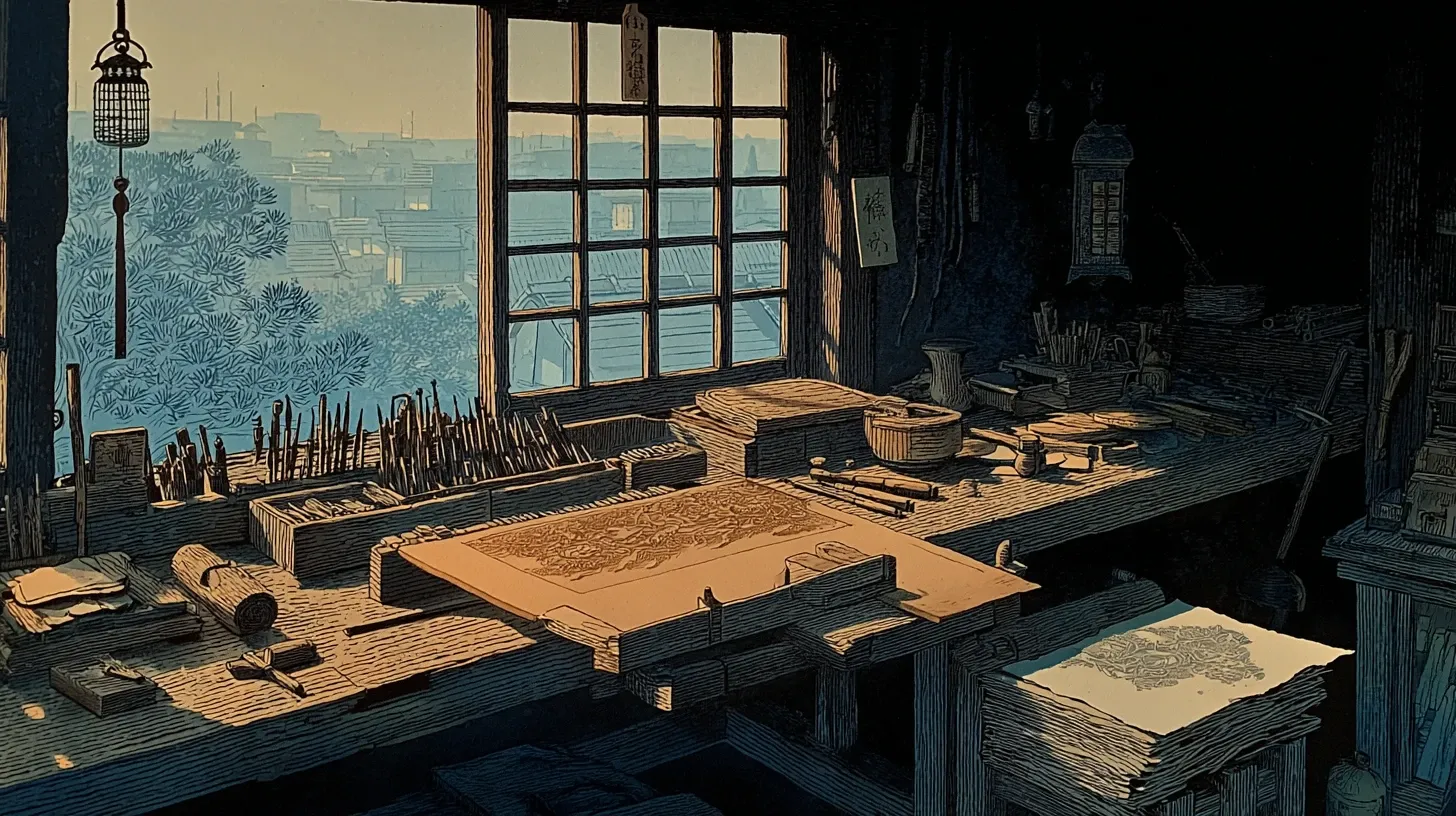
The prints show Mount Fuji from city rooftops in Edo, from rice fields, from the windows of brothels, from beneath bridges, from the deck of fishing boats, from the workbenches of barrel-makers, from the inside of a tea house, from the slopes of the mountain itself. In some prints, Fuji dominates the composition. In others, it is a barely visible triangle in the distance, almost incidental to the scene of human life in the foreground.
This was a structural innovation. Earlier landscape art treated a famous place as a singular icon. Hokusai treated Fuji as a constant — a fixed reference point against which the variety of human existence could be measured. The mountain stays the same; everything around it changes. That structure would later influence European Impressionism, particularly Monet’s series paintings of haystacks and Rouen Cathedral, which use the same conceit of fixed subject against shifting conditions.
The series was also a technical breakthrough. The prints used Prussian blue — a synthetic pigment that had been imported to Japan from Europe through the Dutch trading station at Nagasaki. The deep, stable blue of Prussian blue allowed Hokusai to create the saturated water and sky tones that became the visual signature of the entire series. Before Prussian blue, Japanese woodblock prints used vegetable-based blues that faded quickly. Hokusai’s prints have not faded. They look today essentially as they did in 1832.
The Great Wave — What Is Actually Happening in the Picture
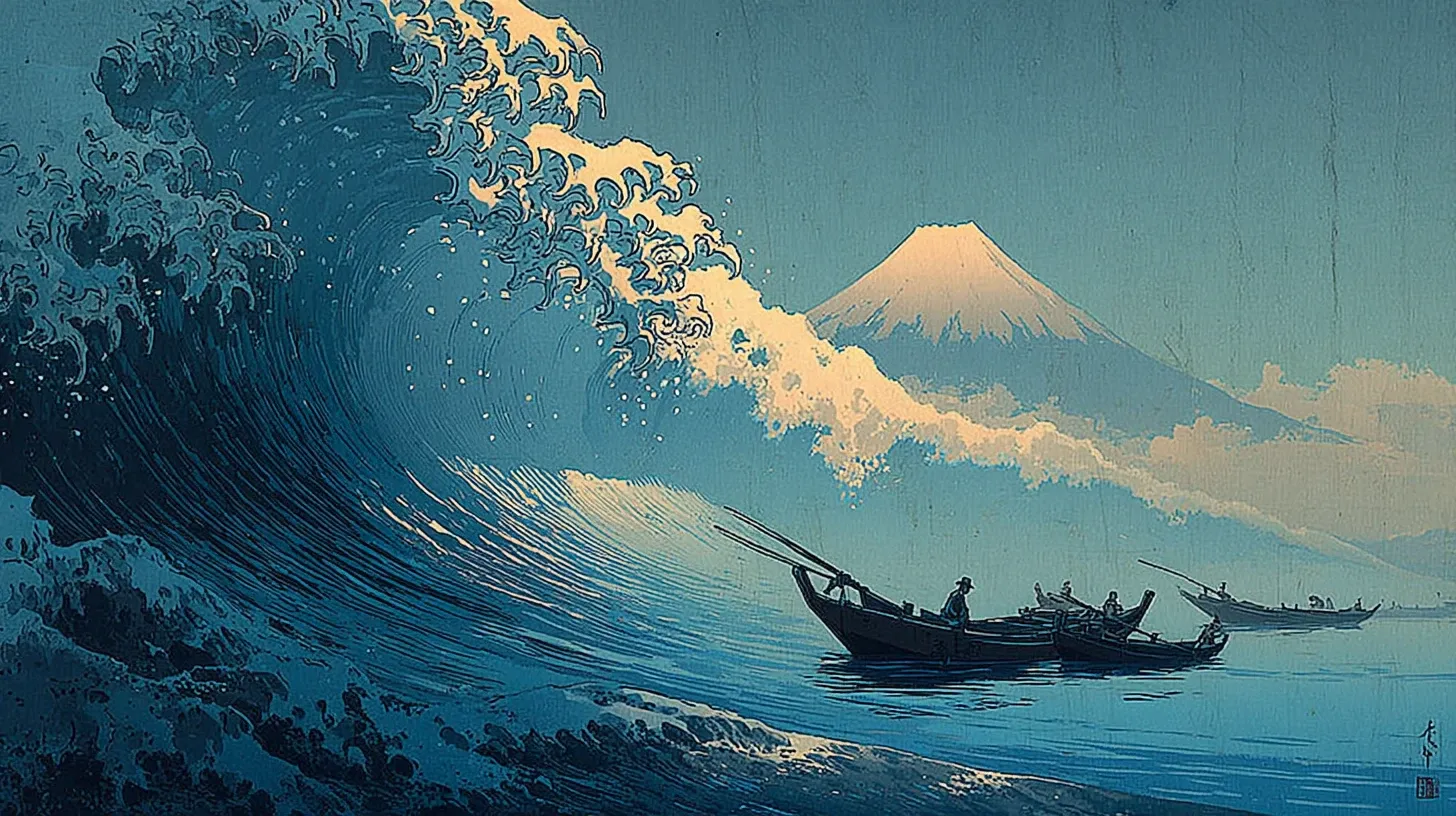
The most famous print in the series — and one of the most reproduced images in human history — is Kanagawa-oki Nami-ura, “Under the Wave off Kanagawa,” now universally called The Great Wave.
It is worth slowing down and looking at what the print actually shows. Most casual viewers see “a wave and a mountain.” That description misses almost everything that makes the picture work.
First, the wave is enormous and the mountain is tiny. Hokusai’s compositional trick is a play on perspective. Mount Fuji — Japan’s tallest mountain at 3,776 meters — appears as a small white triangle in the distance, partially framed by the curling lip of the wave. The wave appears to be towering over the mountain, even though the mountain is roughly thirty kilometers away from the boats in the foreground. This is geometrically impossible in any normal sense, and Hokusai knew it. He wanted the viewer to feel the smallness of even the most sacred mountain in Japan in the face of the sea’s power.
Second, there are people in the boats. Three long fishing boats — oshiokuri-bune, used to transport fresh fish to Edo — lie low in the water beneath the wave. The boatmen are crouched, gripping the gunwales, riding out a swell that looks like it might destroy them. They are not heroic figures. They are workers in the middle of a difficult morning.
Third, the wave’s foam is shaped like claws. Look closely at the spray peeling off the top of the wave. The white foam tendrils have been compared, repeatedly across two centuries of art criticism, to the claws of a dragon — a deliberate visual reference to the uminari, the spirit of the sea in Japanese folk belief. Other commentators see ghosts (yūrei), or skeletons, or the curl of a hand reaching out. Hokusai never explained what he intended. The print invites all of these readings.
Fourth, the print is meant to be looked at left-to-right, like Japanese reading order. The wave begins on the left, builds, and crashes toward the right side of the frame, where Mount Fuji sits. In Western viewing habits, the eye often moves opposite — left to right — and the wave appears to be receding. In Japanese reading order, the wave is advancing, and Fuji is in its path.
Once you see the print this way, the casual reading (“a wave and a mountain”) gives way to something more specific: a meditation on the relationship between human work, natural force, and sacred constancy, all compressed into a single moment that has not yet resolved.
Hiroshige’s Fuji — The View from the Road
If Hokusai’s Fuji is a mountain seen from forty-six different vantage points, Utagawa Hiroshige’s Fuji is a mountain seen from a road.
Hiroshige (1797–1858) was Hokusai’s younger contemporary and rival, and his most famous work — The Fifty-Three Stations of the Tōkaidō (1833–1834) — was published just one year after Hokusai’s Thirty-Six Views. The Tōkaidō was the main highway connecting Edo (modern Tokyo) and Kyoto, a journey of roughly 500 kilometers that took about two weeks on foot. Travelers passed through fifty-three official post stations along the way, and Hiroshige depicted each one as a separate print.
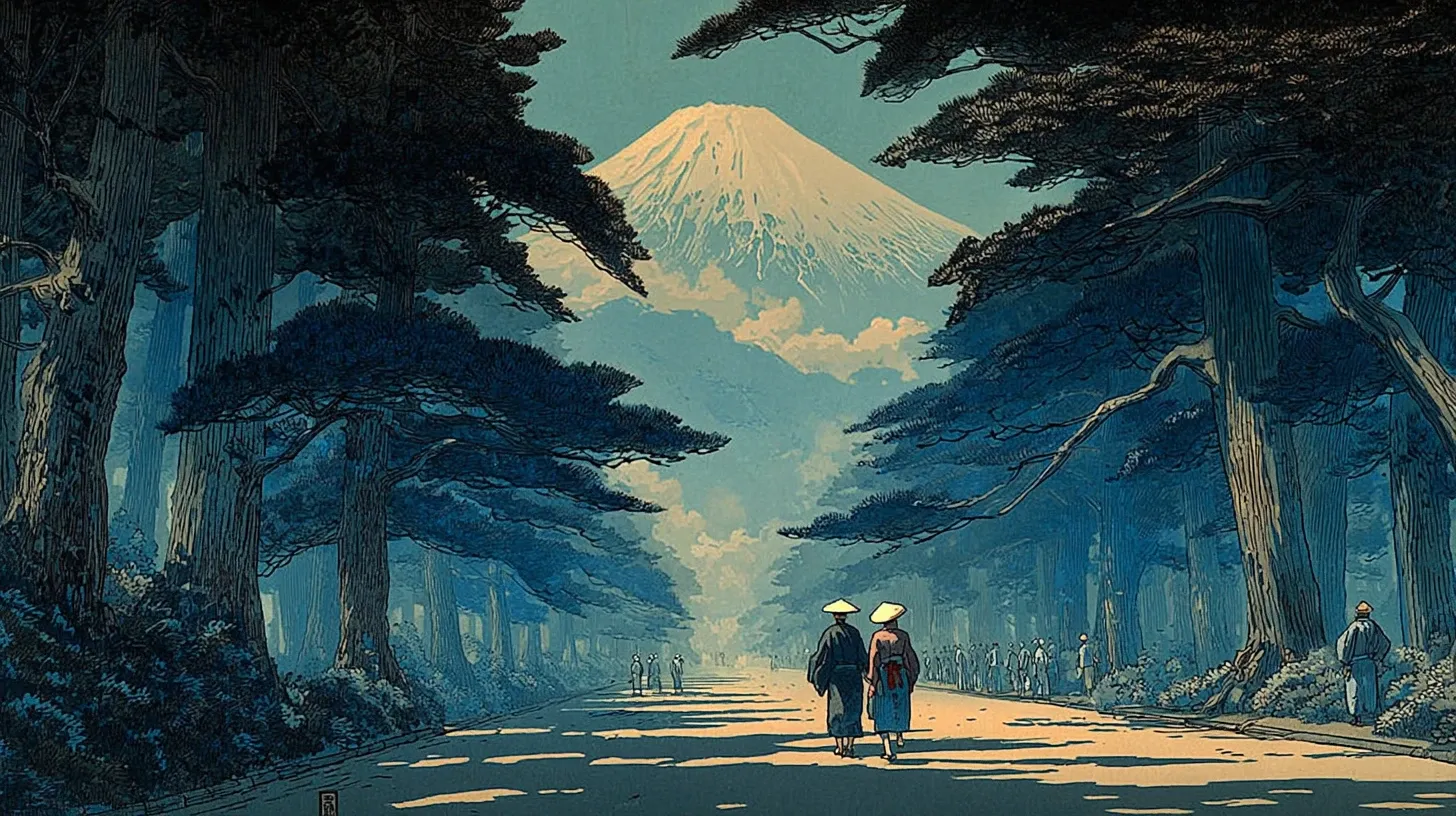
Mount Fuji appears in many of these prints, sometimes as the main subject, often as a presence on the horizon. In the print Hara (Station 13), the mountain dominates the entire upper half of the composition, dwarfing the small travelers on the road below. In Yui (Station 16), it is glimpsed across a bay through pine trees. In Ejiri (Station 17), it rises above a fishing harbor. The series captures something Hokusai’s set could not: the experience of seeing the same mountain repeatedly, from new angles, as you actually walk past it.
Hiroshige’s later series Thirty-Six Views of Mount Fuji (1858) — directly modeled on Hokusai’s earlier set — added another forty-six different views. By the time he completed it, Hiroshige and Hokusai had together produced almost a hundred different prints of the same mountain. Neither artist seemed to feel the subject was exhausted.
If Hokusai’s Fuji is mythological — a mountain that can be towered over by a wave or framed by a barrel-maker — Hiroshige’s Fuji is geographical. It is the mountain you actually saw on the road. It is the sense of a journey unfolding, anchored to a single fixed point on the horizon.
The Shin-hanga Revival — Hasui’s Quiet Mountain
By the early twentieth century, the Edo-period woodblock print tradition had nearly disappeared. The fall of the Tokugawa shōgunate in 1868 had upended the publishing industry that supported ukiyo-e artists. Photography had taken over the documentary role that prints had played for two centuries. Mass-printed lithographs and oil paintings had taken over the popular art market.
Then, in the 1900s, a Tokyo publisher named Watanabe Shōzaburō had an idea. He would revive the woodblock print tradition — but as an art form rather than a commercial product, designed for connoisseurs rather than mass consumption. He recruited a small group of young painters and trained them in the disappearing techniques of woodblock printing. The movement they created was called shin-hanga — new prints.
The most prolific and most loved of the shin-hanga artists was Kawase Hasui (1883–1957). Over his forty-year career, Hasui produced more than six hundred prints of Japanese landscapes — temples in snow, rural villages at dusk, lakes under moonlight, country roads in rain. He was particularly drawn to Mount Fuji, which appears in dozens of his prints.
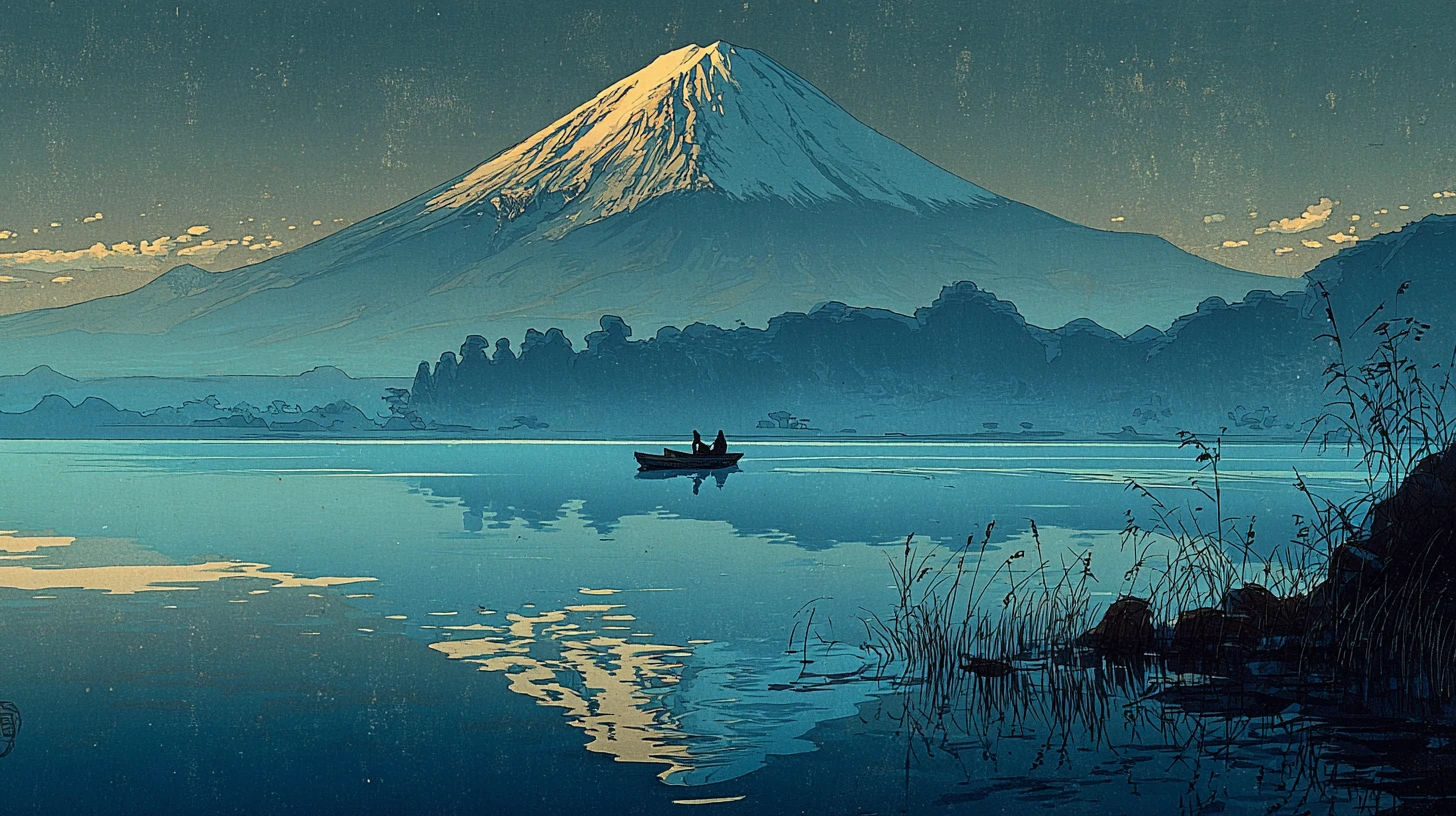
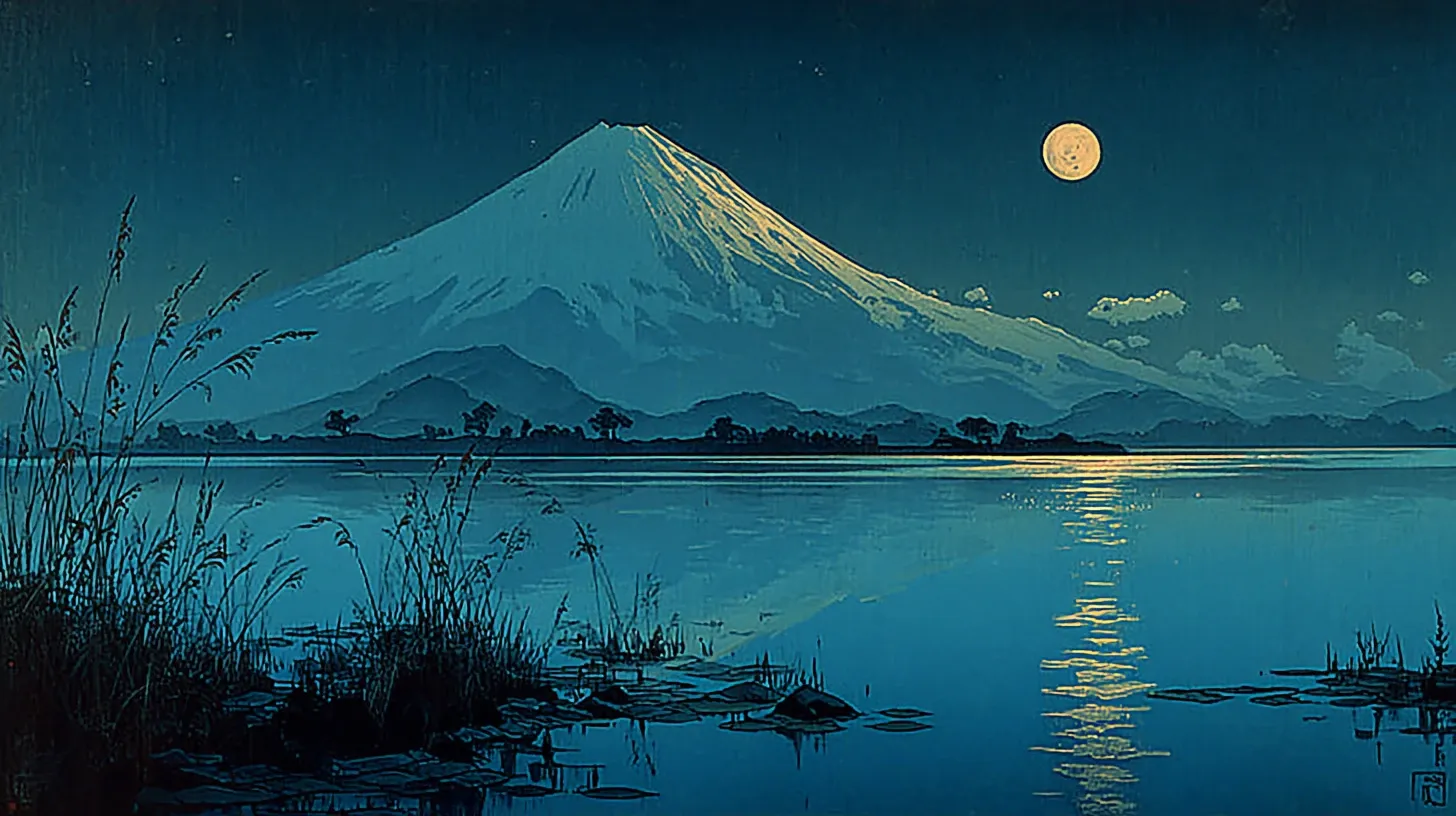
Hasui’s Fuji is fundamentally different from Hokusai’s or Hiroshige’s. The Edo-period masters had been working for a popular audience that expected drama, contrast, and recognizable storytelling. Hasui was working for a modern audience that valued mood, atmosphere, and quiet introspection. His prints are softer, more atmospheric, more deeply colored. The compositions are simpler. The light is often crepuscular — the moments just before sunrise or just after sunset, when the world is half in shadow.
Look at Hasui’s Mount Fuji from Lake Tagonoura or his Lake Kawaguchi prints, and you see a mountain almost dissolved into the surrounding atmosphere — a presence rather than a subject. The Fuji of the Edo masters announces itself. Hasui’s Fuji whispers.
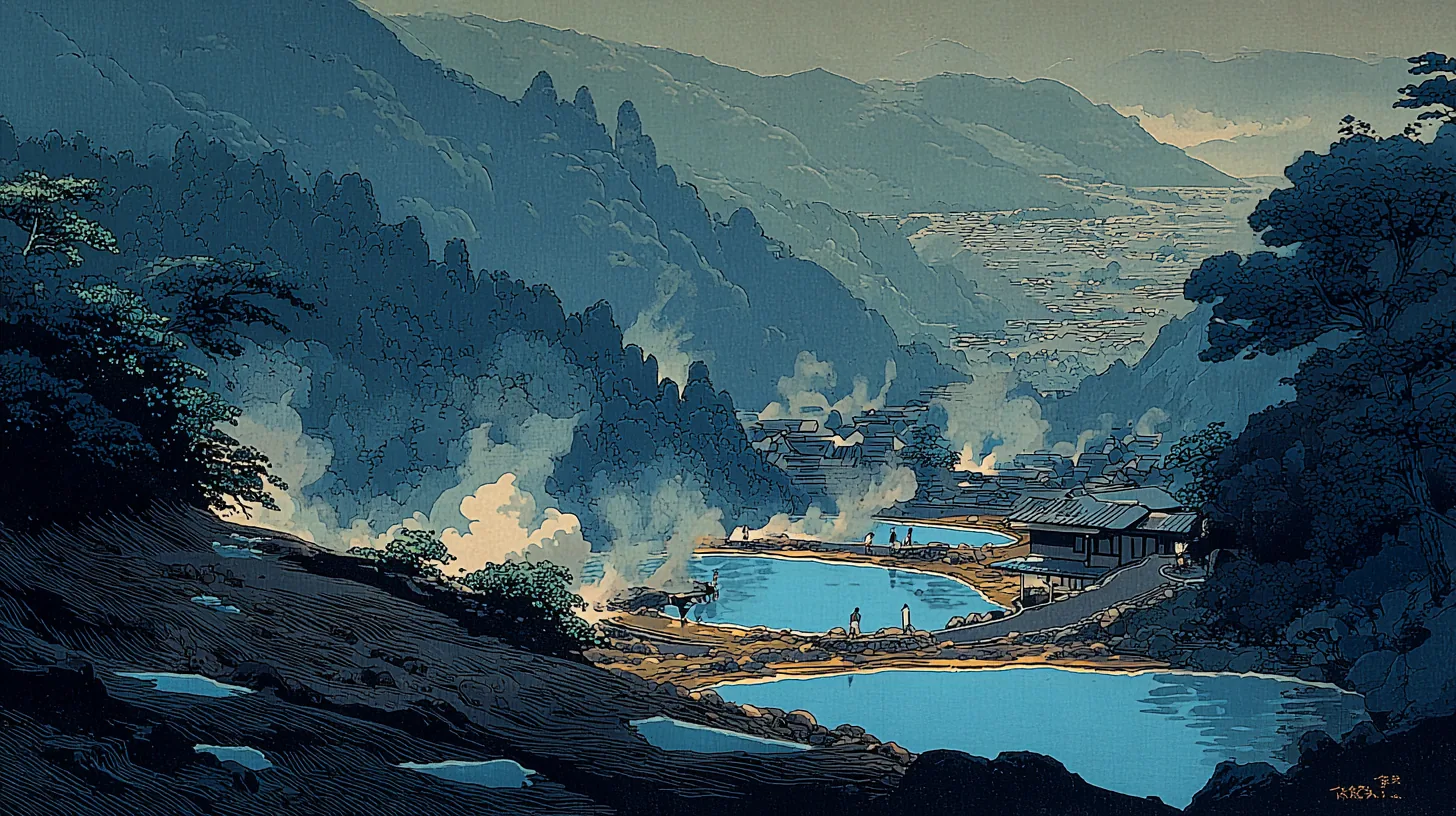
This is the visual tradition that Sleepy Tales of Japan draws on for the imagery in our sleep stories. The shin-hanga style — Hasui’s quiet landscapes in particular — was developed for an audience that wanted to slow down, look carefully, and feel small in the presence of beauty. It has aged well into the twenty-first century, and it remains one of the most distinctively Japanese visual languages ever created.
Why Mount Fuji? — The Visual Logic of an Icon
A reasonable question is: why this mountain? Japan has many mountains. Some are taller (none are, actually — Fuji is the tallest), but many are more dramatic, more difficult, more interesting topographically. Why has this triangle held the attention of three centuries of artists?
There are at least four reasons.
Symmetry. Fuji is, almost uniquely among the world’s great mountains, a near-perfect cone. The slope angle on the west, east, north, and south faces is virtually identical. Most mountains look different from different sides. Fuji looks essentially the same from every angle. For an artist, this means the mountain remains recognizable no matter where you stand. You can paint it from a hundred different positions and the viewer always knows what they are looking at.
Isolation. Fuji rises alone from a wide plain. It is not part of a range. There is no surrounding silhouette to compete with it on the horizon. This isolation makes it visually dominant in almost any landscape that includes it, even from very far away. It also means an artist can place Fuji at any distance and at any scale within a composition without the geography becoming confusing.
Seasonal contrast. Fuji holds snow on its upper slopes for most of the year, but the line at which the snow stops changes constantly with the seasons. In winter, the snow descends almost to the base. In late summer, it retreats to the very top, and for a few weeks Fuji is dark gray-green. The same mountain becomes visually different in every month — which is exactly what an artist wants when planning a series of forty-six different views.
Cultural saturation. By the time Hokusai painted the Thirty-Six Views, Mount Fuji had already been venerated for a thousand years. Every Japanese viewer, even those who lived hundreds of kilometers from the mountain and had never seen it in person, knew what Fuji meant. The artists could rely on a shared visual vocabulary. They could trust that an audience would respond emotionally to even a glimpsed triangle on the horizon.
The combination — geometric perfection, visual isolation, seasonal mutability, cultural pre-loading — is what made Fuji uniquely suited to repeated artistic depiction. Other mountains have one or two of these qualities. Fuji has all four.
Where to See Original Prints in Japan
Original Edo-period prints of The Great Wave and the rest of the Thirty-Six Views survive in the hundreds, scattered across museum collections worldwide. Several major Japanese museums hold strong collections you can visit.
Sumida Hokusai Museum (Tokyo). This museum, opened in 2016 in the neighborhood where Hokusai was born and lived most of his life, is the single most focused Hokusai institution in the world. The permanent collection includes high-resolution reproductions of all major works and a life-sized model of Hokusai’s cluttered late-life studio. Special exhibitions rotate original prints from the museum’s holdings. Admission is ¥400 — an extraordinary value for what you see.
Tokyo National Museum (Ueno). Japan’s largest art museum holds rotating exhibitions from its substantial ukiyo-e collection, which includes original Hokusai and Hiroshige prints. The Honkan (Japanese Gallery) usually has at least one display case dedicated to woodblock prints at any time.
Ōta Memorial Museum of Art (Harajuku, Tokyo). A small but excellent museum dedicated entirely to ukiyo-e. Exhibitions change monthly, and the collection includes major works by Hokusai, Hiroshige, Utamaro, and Sharaku. The atmosphere is more intimate than the larger institutions.
MOA Museum of Art (Atami). This museum, set on a hillside above Atami with a panoramic view of Sagami Bay, holds a significant collection of Japanese art including original ukiyo-e prints. Worth combining with an Atami onsen visit.
Yamanashi Prefectural Museum (Kōfu). Located in the prefecture that contains the northern slopes of Mount Fuji, this museum holds a strong collection of Fuji-themed prints and paintings, with particular emphasis on shin-hanga artists including Kawase Hasui.
If you want to see Hasui specifically, the rotating exhibitions at Tokyo galleries — particularly Watanabe Print Studio in Ginza, the institutional descendant of the publisher who launched the shin-hanga movement — display original prints regularly and sell limited modern reprints.
For broader context on Mount Fuji itself — its geology, mythology, and the lakes and towns that surround it — see the complete Mount Fuji guide and the Chureito Pagoda guide, which together cover the modern landscape that these centuries of artists were depicting.
Continue Reading
- Mount Fuji: The Complete Guide — the hub article on the mountain these artists painted.
- Is Mount Fuji Still an Active Volcano? — the geological reality behind the silhouette.
- Mount Fuji’s Five Lakes — the volcanic landscape Hokusai also drew.
- Chureito Pagoda: The Most Photographed View — the modern photo that completes the 300-year tradition.
FAQ
Who painted The Great Wave off Kanagawa?
The Great Wave (full title: Under the Wave off Kanagawa) was created by Katsushika Hokusai around 1831, when he was approximately 70 years old. It is the first and most famous print in his series Thirty-Six Views of Mount Fuji (Fugaku Sanjūrokkei), produced from approximately 1830 to 1832 with ten additional prints added later for a total of forty-six.
Is Mount Fuji actually visible in The Great Wave?
Yes, but small. Mount Fuji appears as a white triangular peak in the middle distance of the composition, partially framed by the curl of the cresting wave. Hokusai used a deliberate trick of perspective to make the wave appear to tower over the mountain — geometrically impossible, since Mount Fuji is roughly 30 kilometers away from the boats in the foreground, but visually striking. The contrast between the dynamic wave and the still mountain is the whole point of the composition.
What is shin-hanga and how is it different from ukiyo-e?
Both are Japanese woodblock print traditions, but separated by about a century and made for different audiences. Ukiyo-e (“pictures of the floating world”) was the popular print art of the Edo period (1603–1868), produced for ordinary urban consumers and depicting actors, courtesans, and famous places. Shin-hanga (“new prints”) was a twentieth-century revival movement, started around 1915 by publisher Watanabe Shōzaburō, designed for art collectors. Shin-hanga prints are typically softer, more atmospheric, and more deeply colored than ukiyo-e, reflecting Western influences absorbed during the Meiji era. Kawase Hasui is the most famous shin-hanga landscape artist.
Why is Mount Fuji so often depicted in Japanese art?
Four reasons combine to make Fuji uniquely suited to repeated artistic depiction. Symmetry — Fuji is a near-perfect cone visible essentially the same from every angle, making it instantly recognizable from any vantage point. Isolation — it rises alone from a wide plain with no other peaks to compete with on the horizon. Seasonal mutability — the snow line shifts constantly through the year, making the same mountain visually different in every month. Cultural saturation — Mount Fuji has been venerated in Japan for over a thousand years, so artists could rely on viewers to respond emotionally to even a small triangle on the horizon. No other mountain in the world combines all four qualities.
Where can I buy authentic Japanese woodblock prints of Mount Fuji?
Authentic original Edo-period prints (Hokusai, Hiroshige) are museum-quality items selling for hundreds of thousands of dollars at international auction houses. Most prints sold to tourists are modern reproductions printed from new woodblocks. Quality varies widely — the best modern reproductions are made by traditional workshops using the same techniques as the originals. Watanabe Print Studio in Ginza, Tokyo (the institutional descendant of the shin-hanga publisher) sells limited authorized modern reprints of historical works, including Hasui prints, at prices from ¥30,000 to ¥300,000 depending on edition and rarity. For genuine Edo-period prints, reputable auction specialists in Japan or abroad are essential.
What is “Prussian blue” and why does it matter?
Prussian blue is a synthetic blue pigment first manufactured in Berlin in 1704. It reached Japan through the Dutch trading station at Nagasaki in the early nineteenth century. Hokusai was one of the first Japanese print artists to use it extensively, and the deep, stable blues of The Great Wave and the rest of the Thirty-Six Views are largely Prussian blue. Earlier Japanese woodblock prints used vegetable-based blues that faded quickly with light exposure. Prussian blue does not fade. Original Hokusai prints from 1832 still show essentially the same blue tones today as they did when first printed — one reason these works survive in such striking visual condition nearly two centuries later.
Sources
- The Great Wave off Kanagawa — Wikipedia — Wikipedia
- Thirty-Six Views of Mount Fuji — Wikipedia — Wikipedia
- Under the Wave off Kanagawa — The Met — Metropolitan Museum of Art
- The Great Wave — Art Institute of Chicago — Art Institute of Chicago
- Sumida Hokusai Museum — Sumida Hokusai Museum
- Kawase Hasui — Wikipedia — Wikipedia
- Watanabe Print Studio — Watanabe Print Studio (publisher of shin-hanga since 1915)