Mount Fuji: The Complete Guide — 2.6 Million Years of Eruptions, Five Lakes, and Everything to See Around Japan's Active Volcano
- Sleepy Tales of Japan
- 22 min read In-depth
On a clear day, you can see Mount Fuji from over eighty separate locations — including, sometimes, the window of your hotel room in central Tokyo. The question for most travelers is not whether you will see Japan’s most famous mountain. The question is how close you want to get, what kind of view you want, and whether you want to do anything besides look.
The short version: you do not need to climb Mount Fuji to experience it. A clear day from Tokyo or Yokohama will give you a postcard glimpse. A day trip to Hakone will give you the mountain rising behind hot spring towns. Two days around Kawaguchiko will give you the lakes, the famous pagoda, the cherry blossoms in season, and the version of Mount Fuji that has appeared in art for the last three hundred years. Climbing is a serious overnight commitment, only available July through early September, and worth it if that is what you came for — but most visitors do not need it.
Mount Fuji is not one thing. It is a volcano that has erupted eighteen times in recorded history and has been silent for more than three centuries. It is a Shinto deity’s home, a pilgrim’s destination, and a subject that three generations of artists could not stop painting. It is surrounded by five lakes born from its own lava and watched over by shrines built to calm its fire. This guide brings together everything you need to understand and experience the mountain — its history, its landscape, the climbing routes if you want them, and the places around it that exist because of the volcano.
Table of Contents
Open Table of Contents
The Sacred Mountain — Mythology and Geology
Mount Fuji stands 3,776 meters above sea level — Japan’s highest peak and its most recognizable silhouette. But the mountain you see today is actually the third volcano built on the same spot. Over 2.6 million years, three volcanoes stacked on top of one another: Komitake at the bottom, Old Fuji in the middle, and New Fuji — the current cone — on top.
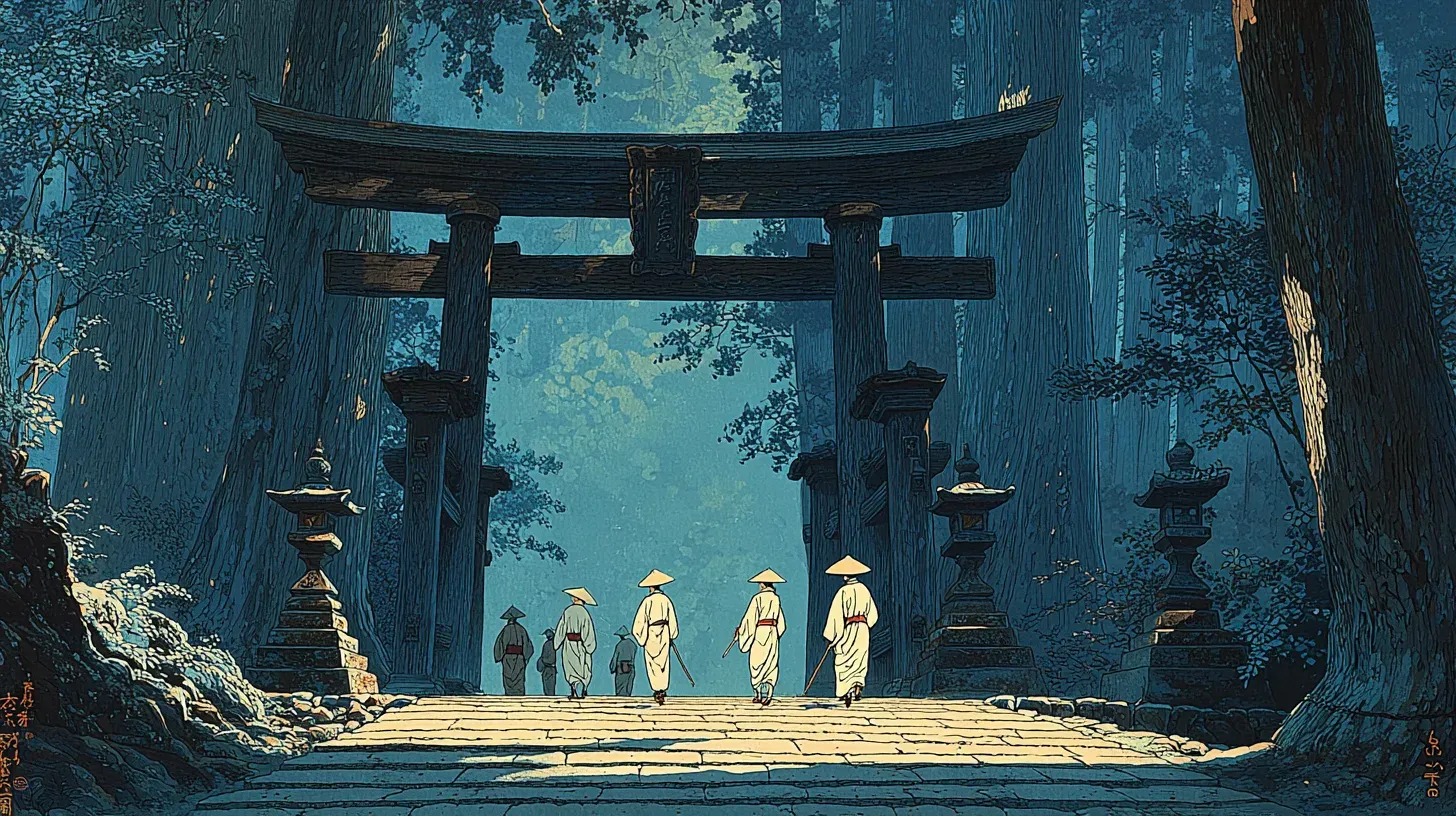
The mountain’s religious significance is older than any written record. In Shinto belief, the goddess Konohanasakuya-hime dwells at the summit. According to myth, she proved her faithfulness to her husband by giving birth inside a burning hut — a story that links the goddess of safe childbirth to the fire within the volcano itself. Sengen shrines were built at the mountain’s base to pacify the deity, and by the ninth century, Fuji worship was recognized by the imperial court.
During the Edo period, a folk religious movement called Fuji-kō transformed the mountain from an ascetic’s proving ground into a commoner’s pilgrimage. Neighborhood associations in Edo pooled money to send representatives to the summit each year. For those who could not make the journey — women, children, the elderly — miniature replica mountains called Fuji-zuka were built in shrine grounds across the city. At their peak, roughly 800 of these miniature Fujis dotted the streets of Edo.
The last eruption, in 1707, sent ash raining on Edo — modern Tokyo, a hundred kilometers away — and darkened the midday sky. The resulting crop failures caused nearly a decade of famine. That eruption also created Hōei-zan, the bump on Fuji’s southeastern flank that breaks the mountain’s otherwise perfect symmetry.
In 2013, Mount Fuji was inscribed as a UNESCO World Cultural Heritage site — not for its natural beauty, but for its centuries of spiritual and artistic significance. The official title says it all: “Fujisan, Sacred Place and Source of Artistic Inspiration.”
Read the full story: Mount Fuji — The Sacred Volcano That Shaped Japan →
Fuji Five Lakes — Born from Fire
On Mount Fuji’s northern base, five lakes arc around the volcano’s feet. They were not always five. In 864, a massive eruption sent lava pouring down the northwestern slope, splitting a large ancient lake called Senoumi into fragments. Three of the resulting lakes — Saiko, Shōjiko, and Motosuko — still share the same surface elevation and are connected by underground waterways, as if they remember being one.
Each lake has its own character. Kawaguchiko is the most accessible and the place where most visitors first see Sakasa Fuji — the mountain’s inverted reflection in still water. Yamanakako, the largest and shallowest, offers Diamond Fuji, a phenomenon where the setting sun balances on the summit like a gem on a ring. Saiko is the quietest of the five, its southern shore bordered by Aokigahara — the dense forest that grew on the eruption’s cooled lava. In 2010, a fish species declared extinct seventy years earlier was found alive in Saiko’s waters. Shōjiko, the smallest, offers a composition called Kodaki Fuji, where the mountain appears to cradle a smaller peak in its arms. And Motosuko, the deepest, provides the view immortalized on the Japanese 1,000-yen bill from 1984 to 2024.
Between the lakes, the village of Oshino preserves eight crystal-clear spring ponds — Oshino Hakkai — fed by snowmelt that takes more than twenty years to filter through volcanic rock. Edo-period pilgrims purified themselves here before climbing the sacred mountain.
Explore the lakes: Fuji Five Lakes — Born from Fire, Shaped by Water →
Climbing Mount Fuji — The Four Trails
The climbing season
Mount Fuji’s official climbing season is short. The Yoshida Trail (Yamanashi Prefecture side) opens July 1 and closes September 10. The three Shizuoka Prefecture trails — Fujinomiya, Subashiri, and Gotemba — open July 10 and also close September 10. The exact opening date can shift by a few days depending on snowfall and weather conditions, so check the official Mt. Fuji Climbing website before planning.
During these roughly ten weeks each summer, the mountain huts are staffed, the trails are maintained, rescue stations are open, and mobile phone coverage is extended via temporary base stations. Outside this window, none of that infrastructure exists.
The four trails
Four trails lead from the fifth station — roughly 2,300 meters — to the summit. The Yoshida Trail on the northern side is the most popular, accounting for more than half of all climbers. It is also the most developed, with the largest number of mountain huts and the easiest access from Tokyo. The Fujinomiya Trail on the southern side is the shortest but steepest route. The Subashiri Trail passes through a forest zone before joining the Yoshida Trail near the eighth station. And the Gotemba Trail is the longest and least crowded — chosen by experienced hikers who want solitude and a dramatic descent down volcanic gravel called sunabashiri, the “sand run.”
How most people climb
Most climbers begin in the afternoon, stay overnight in a mountain hut at the seventh or eighth station, and resume climbing before dawn to reach the summit for goraiko — sunrise viewed from above the clouds. The sight of the sun rising over a sea of cloud is the reason most people climb. It is also the reason the trails are crowded between 2:00 and 5:00 AM.
Mountain hut reservations are essential — they fill up weeks in advance during peak season. Do not attempt a one-day round trip. The official Mt. Fuji Climbing website explicitly warns against “bullet climbing” (dangantozan), in which climbers depart at night without sleeping and push straight to the summit. Sleep deprivation combined with rapid altitude gain dramatically increases the risk of altitude sickness, hypothermia, and exhaustion. At 3,776 meters, the summit’s air pressure is roughly 63% of sea level, and even during summer, nighttime temperatures can drop below freezing.
Fees, reservations, and equipment checks
Since 2024, all climbers pay a mandatory entrance fee of 2,000 yen. Additionally, the Yoshida Trail charges a separate trail usage fee of 4,000 yen, is capped at 4,000 climbers per day, and requires advance online reservation. Between 4:00 PM and 3:00 AM, the Yoshida Trail gate opens only for climbers with confirmed mountain hut reservations.
Rangers conduct equipment checks at every trailhead gate. You will not be allowed through without hiking boots (not sneakers), a rain jacket and rain pants (separate top and bottom, not a poncho), a headlamp, warm layers, food, and water. The mountain has no trash bins above the fifth station — everything you carry up, you carry down.
For the latest fees and reservation requirements on each trail, check the official websites for Yamanashi Prefecture (Yoshida Trail) and Shizuoka Prefecture (Fujinomiya, Subashiri, Gotemba Trails).
Off-season: the mountain is closed — and deadly
Outside the climbing season, all trails from the fifth station to the summit are legally closed under Article 46 of Japan’s Road Act. Violation can result in imprisonment of up to six months or a fine of up to 300,000 yen.
This is not a formality. Winter Mount Fuji is one of the most dangerous mountains in Japan. The summit’s average minimum temperature from November through April drops below minus 10 degrees Celsius, and the average wind speed exceeds 15 meters per second — with gusts that can surpass 40 meters per second. The slopes become sheets of ice so hard that crampons barely grip. A single slip on this surface can send a climber into an uncontrollable slide down thousands of meters of frozen volcanic gravel, with no way to self-arrest. Between 1956 and 2013, at least 293 people died on the Yamanashi Prefecture side of the mountain alone.
Mountain huts, rescue stations, and toilets are all shuttered. Trail markers and guide ropes are removed. Mobile phone base stations are powered down. If an accident occurs, rescue teams may not be able to reach the site for days due to weather conditions — and attempting a rescue puts the rescuers’ lives at risk as well.
Even experienced, well-equipped mountaineers have died on winter Fuji. In 1972, a sudden storm killed 24 people in a single incident on the Gotemba route. In 2019, a climber live-streaming his ascent slipped on ice near the summit and fell to his death on camera. These are not isolated cases — fatal falls on the icy slopes occur every year during the closed season.
The official Mt. Fuji Climbing website is unequivocal: do not climb Mount Fuji outside the official season. If you see the mountain dusted in snow and think it looks inviting, understand that what you are looking at is a 3,776-meter ice wall with hurricane-force winds and no rescue infrastructure.
Mount Fuji in Art — From Hokusai to Hasui
No mountain in the world has been painted, printed, and photographed more often than Mount Fuji. Three artists, across three centuries, defined how the world sees this mountain.
Katsushika Hokusai began his series Thirty-Six Views of Mount Fuji around 1830, when he was seventy years old. The series eventually grew to forty-six prints, each showing Fuji from a different location, season, or weather condition. The Great Wave off Kanagawa — technically a picture of Fuji seen through a crashing wave — became one of the most reproduced images in history. Hokusai’s Fuji is dramatic, powerful, and restless. It sits behind fishermen, travelers, and barrel-makers, a constant presence in the background of daily life.
Utagawa Hiroshige, a generation younger, brought a different sensibility. His Fifty-Three Stations of the Tōkaidō depicted the mountain as travelers along the coastal highway would have seen it — sometimes distant, sometimes dominant, always shaped by weather and mood. Where Hokusai composed with force, Hiroshige composed with atmosphere. His Fuji is lyrical, suffused with rain and mist.
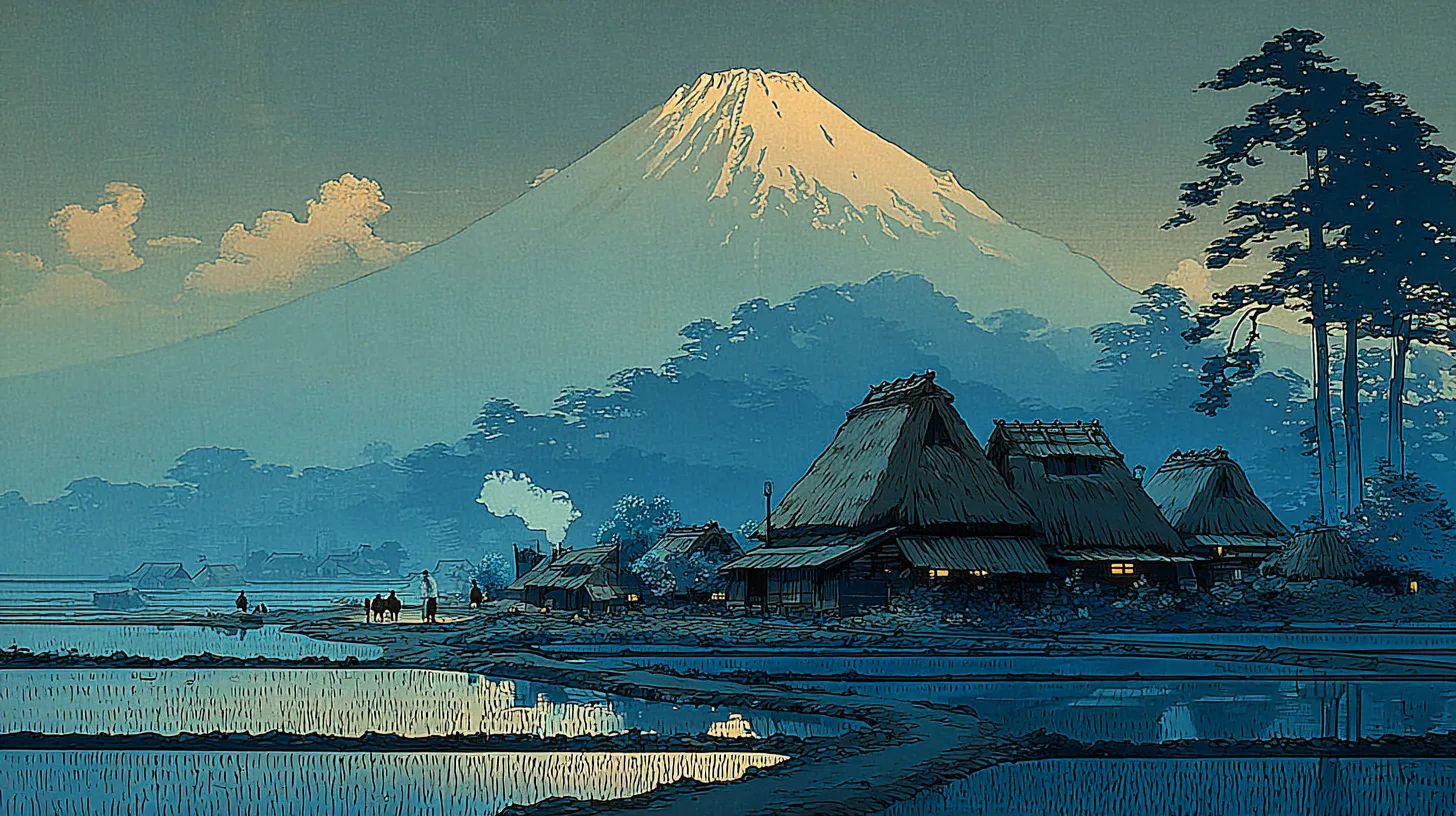
A century later, Kawase Hasui revived the woodblock tradition through the shin-hanga (new print) movement. Hasui’s Fuji appears in twilight, in snowfall, and in the blue hour before dawn — rendered with a palette of thirty or more colors where Hokusai used seven. His prints feel like memories: quiet, precise, and touched with nostalgia for a landscape already beginning to change.
In 1935, photographer Okada Kōyō captured Fuji reflected in Lake Motosuko. That single photograph appeared on the 1,000-yen bill for forty years. Every person in Japan carried this view in their wallet.
Hakone — Hot Springs with a View of Fuji
Hakone sits inside the caldera of an ancient volcano — not Fuji, but its neighbor, Mount Hakone, which last erupted roughly 3,000 years ago. The result is a landscape of hot springs, a crater lake, volcanic vents, and, on clear days, one of the most photographed views of Mount Fuji across water.
The town has been a hot spring destination since the Nara period (710–784). By the Edo period, “the Seven Hot Springs of Hakone” were famous stops on the Tōkaidō highway connecting Edo to Kyoto. The Hakone Checkpoint — one of the shogunate’s most important border controls — screened travelers passing through the mountains. Today, a reconstruction of the checkpoint and its museum stand near the original site on the shore of Lake Ashi.
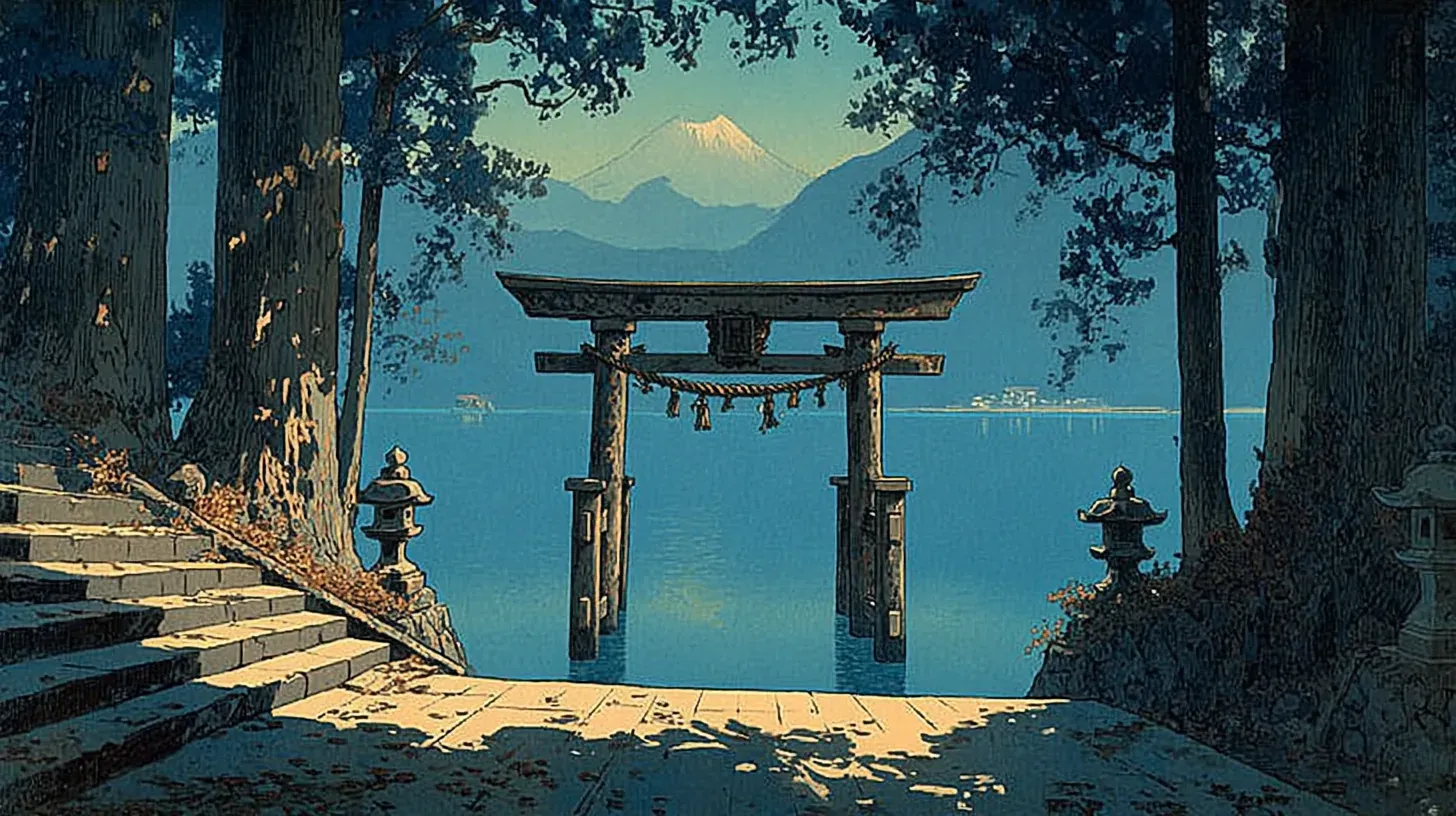
Lake Ashi itself is a crater lake formed by the same eruption that shaped the caldera. On calm mornings, Mount Fuji appears across the water with the lake’s distinctive red torii gate and sightseeing pirate ships in the foreground — a composition that is one-part sacred, one-part surreal, and entirely Hakone.
At Ōwakudani — the “Great Boiling Valley” — volcanic gases still rise from sulfurous vents. The area’s famous black eggs, boiled in sulfurous hot spring water until their shells turn jet black, are said to add seven years to your life. Whether or not that is true, they taste like ordinary eggs with an extraordinary story.
From Tokyo, Hakone is ninety minutes by Odakyu Romancecar from Shinjuku — close enough for a day trip, though the concentration of hot spring inns makes it worth an overnight stay.
Fujiyoshida — The Sacred Gateway Town
Before there was tourism, there was pilgrimage. And the pilgrims’ route to Mount Fuji’s summit began in Fujiyoshida.
The town sits at the northern base of the mountain and has served as the starting point for the Yoshida Trail — the most popular climbing route — for centuries. Kitaguchi Hongu Fuji Sengen Shrine, founded according to tradition in 110 AD, is the spiritual gateway. Its towering stone torii gate marks the boundary between the everyday world and the sacred mountain. During the Edo period, Fuji-kō pilgrimage groups walked through this gate before beginning their ascent, and the town’s main street was lined with oshi — lodging houses run by mountain priests who served as guides and spiritual intermediaries.
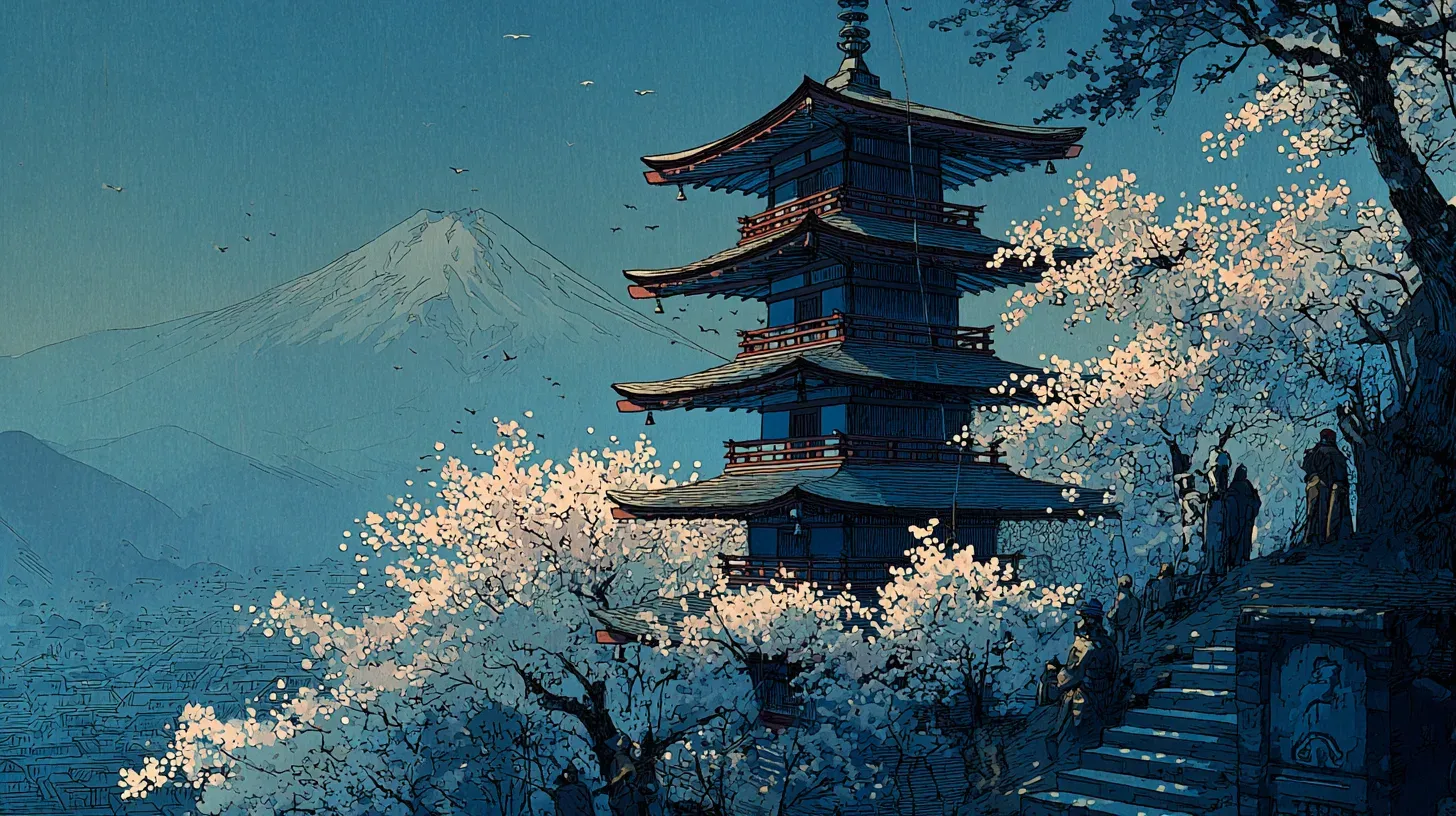
Today, Fujiyoshida is better known for a view that did not exist until 1963. The Chureito Pagoda — a five-story peace memorial within the grounds of Arakura Fuji Sengen Shrine — stands at the top of 398 stone steps on a hillside overlooking the town. From the observation deck beside the pagoda, Mount Fuji rises behind layers of rooftops and, in spring, cherry blossoms. This composition has become one of the most shared images of Japan on social media, though the shrine itself dates to 705 AD and has a history far deeper than its Instagram fame suggests.
The town is also the home of Yoshida udon — thick, firm wheat noodles served in a miso or soy broth with shredded cabbage and pickled vegetables. Nearly fifty udon shops line the town’s quiet streets, many operating out of converted private homes with little more than a curtain and a hand-painted sign to mark them.
Planning Your Visit
Seeing Mount Fuji (without climbing)
Mount Fuji is visible from a wide area of central Japan, but the mountain hides behind clouds more often than not. Statistically, Fuji is visible on roughly one in three days throughout the year, and the odds vary dramatically by season.
The best months for clear views are November through February, when cold, dry air sweeps the haze away. Early morning — before 8:00 AM — is your best window, because thermal convection builds clouds around the summit as the day warms. By midday in summer, the mountain is often invisible even from Kawaguchiko, just twenty kilometers away.
If seeing Fuji is a priority, plan for winter and give yourself multiple days. A two- or three-night stay in the Five Lakes area greatly increases your chances.
Getting there from Tokyo
There are three main transport corridors from Tokyo to the Mount Fuji area, each serving a different destination.
To the Fuji Five Lakes (Kawaguchiko): The fastest option is the Fuji Excursion (Fuji Kaiyū) limited express train, running directly from JR Shinjuku Station to Kawaguchiko Station in approximately 2 hours. It is jointly operated by JR East and Fujikyu Railway, with four round trips daily (additional seasonal services). Reservations are required and can be made on the Fujikyu Railway website or at JR ticket counters and machines. The fare is approximately ¥4,200 one way (basic fare + express surcharge). Alternatively, highway buses run from the Shinjuku Expressway Bus Terminal (Busta Shinjuku) to Kawaguchiko approximately every hour, taking about 1 hour 45 minutes and costing around ¥2,200 one way. These buses are operated jointly by Keio Bus and Fujikyu Bus and can be booked on the Highway Bus Dot Com reservation site or the Fujikyu Call Center (0555-73-8181).
To Hakone: The Odakyu Romancecar limited express runs from Shinjuku to Hakone-Yumoto in approximately 90 minutes. Tickets can be booked on the Odakyu Romancecar website or via the EMot app. Consider purchasing the Hakone Free Pass (available as a 2-day or 3-day pass), which covers the Romancecar surcharge discount and unlimited rides on Hakone’s buses, ropeway, cable car, and pirate ship — essentially all transport within the Hakone loop.
To the 5th Station (for climbing): During the climbing season only (July–September 10), direct buses run from Shinjuku to the Yoshida Trail 5th Station in approximately 2.5 hours. Reservations can be made through the Fujikyu Travel climbing bus page. Local shuttle buses also connect Kawaguchiko Station to the 5th Station (approximately 50 minutes, operated by Fujikyu Bus). Note that private cars cannot drive to the 5th Station during the climbing season due to the Fuji Subaru Line traffic restriction (maika kisei) — all visitors must use shuttle buses from designated parking areas.
The climbing season in detail
The official climbing season runs from July 1 (Yoshida Trail) or July 10 (Fujinomiya, Subashiri, Gotemba Trails) through September 10 each year. Outside this window, all trails from the fifth station to the summit are legally closed and the mountain becomes extremely dangerous (see the climbing section above for details).
During the season, expect the following conditions at the summit: daytime temperatures of 5 to 10 degrees Celsius in clear weather, dropping below freezing at night and in rain. Afternoon thunderstorms are common in July and August. Wind, rain, and near-zero visibility can occur on any day, even in midsummer.
Key requirements for climbing:
- Entrance fee: 2,000 yen (all trails, mandatory since 2024). The Yoshida Trail charges an additional 4,000 yen trail usage fee.
- The Yoshida Trail is capped at 4,000 climbers per day. Advance online reservation is required.
- Equipment checks at trailhead gates: hiking boots, rain jacket and pants (separate, not poncho), headlamp, warm layers, food, and water are mandatory. Climbers without proper gear will be turned away.
- Mountain hut reservations are essential. Book weeks in advance for July and August weekends.
- Between 4:00 PM and 3:00 AM, the Yoshida Trail gate admits only climbers with mountain hut reservations.
- The official Mt. Fuji Climbing website strongly warns against “bullet climbing” — ascending without sleeping. Altitude sickness, hypothermia, and exhaustion are serious risks.
What happens when the mountain closes (September 11 onward)
On September 10 at the end of each season, the gates close and the mountain transforms. Mountain huts, rescue stations, and toilets are shuttered for winter. Trail markers and guide ropes are removed. Mobile phone base stations are powered down. From October onward, snow and ice cover the upper slopes, and the summit temperature averages below minus 10 degrees Celsius from November through April, with average winds exceeding 15 meters per second. The slopes become solid ice — a surface so slippery that even crampons and ice axes provide limited grip.
Climbing Mount Fuji outside the official season is not recommended under any circumstances. The trails are legally closed under Japan’s Road Act. There are no rescue services, no shelter, and no communication. Even experienced mountaineers with full alpine equipment have died on winter Fuji. The official position of the Ministry of the Environment, Yamanashi Prefecture, and Shizuoka Prefecture is clear: do not climb.
If you are visiting during the closed season, you can still enjoy Mount Fuji from the base. The Five Lakes, Fujiyoshida, and Hakone offer spectacular views year-round — and winter, ironically, is when the mountain is most clearly visible.
Suggested multi-day itinerary
A practical loop from Tokyo covers the best of Mount Fuji’s surroundings: Hakone (day 1, hot springs and Lake Ashi) → transit via Gotemba or Mishima → Kawaguchiko (day 2, lake views and Oshino Hakkai) → Fujiyoshida (day 2–3, Chureito Pagoda and Yoshida udon) → return to Tokyo. This circuit works year-round for sightseeing. If you visit during the climbing season and want to include the summit, add one night in a mountain hut between Kawaguchiko and Fujiyoshida.
Continue Reading
If Mount Fuji is on your itinerary, you might also be planning these:
- Kyoto Travel Guide — the imperial capital, just a short Shinkansen ride away.
- Japanese Onsen: The Complete Guide — the Hakone hot springs at Fuji’s southern flank.
- Your First Ryokan Stay — where most Fuji-area travelers spend a night.
- Tokyo Was a Swamp Nobody Wanted — the story of the city you can see from Fuji’s summit.
FAQ
How tall is Mount Fuji?
Mount Fuji stands 3,776 meters (12,389 feet) above sea level, making it the highest peak in Japan. The mountain is an active stratovolcano that last erupted in 1707. It is actually the third volcano built on the same spot — three volcanoes stacked over 2.6 million years.
When is the best time to see Mount Fuji?
Mount Fuji is most clearly visible during winter months (November through February), when cold, dry air provides the clearest skies. Early morning before 8:00 AM offers the highest chance of seeing the mountain before clouds develop. The mountain is statistically visible on about one in three days throughout the year, with winter offering the best odds. If seeing Fuji matters to you, plan a multi-day stay rather than a single day trip.
Can you climb Mount Fuji year-round?
No — and attempting to do so outside the official season can be fatal. The climbing season runs from early July to September 10. Outside this window, all trails from the fifth station to the summit are legally closed under Japan’s Road Act (violation may result in up to six months’ imprisonment or a fine of up to 300,000 yen). Winter Fuji is covered in solid ice, with summit temperatures averaging below minus 10 degrees Celsius, winds exceeding 15 meters per second on average (gusts above 40 m/s), and no rescue services, shelter, or mobile phone coverage. Between 1956 and 2013, at least 293 climbers died on the Yamanashi side alone — the majority during the off-season. The Ministry of the Environment and both prefectural governments are unequivocal: do not climb outside the official season under any circumstances.
What is “bullet climbing” and why is it dangerous?
Bullet climbing (dangantozan) means departing the fifth station at night without sleeping in a mountain hut and pushing straight to the summit. Japanese authorities strongly warn against it. Sleep deprivation at high altitude dramatically increases the risk of altitude sickness (headache, nausea, dizziness), hypothermia, and exhaustion. The summit’s air pressure is roughly 63% of sea level. Proper acclimatization requires at least one overnight stay at a mountain hut. During the climbing season, the Yoshida Trail gate closes from 4:00 PM to 3:00 AM for climbers without mountain hut reservations, specifically to discourage this practice.
What are the Fuji Five Lakes?
The Fuji Five Lakes (Fujigoko) are five lakes on the northern base of Mount Fuji, formed by volcanic eruptions over thousands of years. The most significant event was the 864 Jōgan eruption, which split a large ancient lake into three. The five lakes are Kawaguchiko (most accessible), Yamanakako (largest), Saiko (quietest), Shōjiko (smallest), and Motosuko (deepest, featured on the 1,000-yen bill).
How do I get to Mount Fuji from Tokyo?
There are three main routes. To the Fuji Five Lakes (Kawaguchiko): take the Fuji Excursion limited express from Shinjuku (approximately 2 hours, book on the Fujikyu Railway website) or a highway bus from Busta Shinjuku (approximately 1 hour 45 minutes, from ¥2,200, book on Highway Bus Dot Com). To Hakone: take the Odakyu Romancecar from Shinjuku (90 minutes, book on the Odakyu website). For climbing during the official season: direct buses run from Shinjuku to the Yoshida Trail 5th Station (approximately 2.5 hours, book through Fujikyu Travel). Private cars cannot access the 5th Station during the climbing season — shuttle buses are mandatory.
Why is Mount Fuji a UNESCO World Heritage site?
Mount Fuji was inscribed as a UNESCO World Cultural Heritage site in 2013 — notably as a cultural, not natural, site. The designation recognizes the mountain’s centuries of religious significance (Shinto worship, Fuji-kō pilgrimage) and its role as an artistic subject (Hokusai, Hiroshige, Hasui). The heritage site includes 25 component assets: the summit, historic shrines, the Five Lakes, Oshino Hakkai springs, and other sacred sites.
Sources
- Fujisan, Sacred Place and Source of Artistic Inspiration — UNESCO World Heritage Centre
- Mt. Fuji Climbing Official Website — Ministry of the Environment, Yamanashi & Shizuoka Prefectures
- Mt. Fuji Outside the Official Climbing Season — Official Safety Information
- 2026 Yoshida Trail Climbing Regulations
- Fuji Excursion — Fujikyu Railway
- Highway Bus Shinjuku–Kawaguchiko — Highway Bus Dot Com
- Odakyu Romancecar — Booking
- Hakone Free Pass — Odakyu
- Fuji Five Lakes Travel Guide — japan-guide.com
- Hakone Travel Guide — hakone-japan.com
- The Allure of the Fuji Five Lakes — Highlighting Japan (Government of Japan)