Kyoto Was Japan's Capital for 1,074 Years — Longer Than Rome, Survived a World War, and Almost Was Atomic-Bombed in 1945
- Sleepy Tales of Japan
- 13 min read
When the Western Roman Empire collapsed in 476, its seat of power had endured for roughly five centuries. Constantinople sustained the Eastern flame for another millennium, yet it succumbed to shifting empires, structural renamings, and systemic cultural resets. London has functioned as England’s core for nine hundred years, though modern glass and steel retain no physical DNA of the medieval timber lost to fire, plague, and the Blitz.
Kyoto operated under a different geopolitical logic.
Between 794 and 1868—a span of 1,074 years—it remained Japan’s absolute imperial capital. It was never conquered by a foreign power, never systematically renamed, and never erased from the map, despite internal fires that repeatedly liquidated its architecture and a global war that brought atomic devastation to its doorstep. This survival was not a product of geographical invulnerability; it was the result of calculated human interventions, culminating in the summer of 1945 when a single American politician weaponized his own vacation memories to alter the trajectory of the nuclear age.
Table of Contents
Open Table of Contents
- An Emperor Escapes the Monks
- A City Built by Chinese Rules
- The Capital That Kept Burning
- The Ōnin War: When the Capital Destroyed Itself
- The Townspeople Who Rebuilt a Capital
- Capital Without Power
- The War That Almost Ended Everything
- The Move That Wasn’t a Move
- The Thousand-Year Echo
- Continue Reading
- FAQ
An Emperor Escapes the Monks
By 784, Emperor Kanmu realized that the Buddhist clergy had effectively hijacked the state. In Nara, the sovereign capital since 710, massive temples like Tōdai-ji controlled vast agricultural estates, dictated government appointments, and bled the treasury dry to cast monumental bronze deities. The political crisis peaked when Dōkyō, an ambitious faith healer turned monk, attempted to usurp the imperial throne itself—a coup thwarted only by a last-minute palace conspiracy.
Kanmu’s response was radical: absolute abandonment. He did not reform Nara; he walked away from it, aiming to isolate his administration from the predatory economic reach of the monasteries.
| Years | Capital | What happened |
|---|---|---|
| 710–784 | Nara | Buddhist clergy captured state power |
| 784–794 | Nagaoka-kyō | Failed relocation, 10 years |
| 794–1868 | Heian-kyō (Kyoto) | Imperial capital for 1,074 years |
| 1869–present | Tokyo | Functioning capital — no formal demotion of Kyoto |
The escape was messy. His first choice, Nagaoka-kyō, collapsed within a decade under a wave of torrential floods, systemic smallpox outbreaks, and the high-profile assassination of Kanmu’s chief architect. Whispers of vengeful ghosts terrified the court. Panicked, Kanmu ordered the half-built city dismantled and pushed deeper into a broad alluvial basin hemmed in by mountains on three sides, where the Kamo and Katsura rivers provided natural drainage and transport links.
He designated this strategic pocket Heian-kyō: the Capital of Peace and Tranquility.
A City Built by Chinese Rules
Geomancy preceded construction. Heian-kyō did not develop through organic human settlement; engineers imposed a rigid ideological blueprint onto the wilderness, copying the massive gridiron layout of Chang’an, the Tang Dynasty capital that then stood as the world’s largest metropolis.
| Direction | Required guardian | Kyoto’s match |
|---|---|---|
| North | Mountain (Genbu) | Mt. Funayama |
| East | River (Seiryū) | Kamo River |
| West | Road (Byakko) | San’in Highway |
| South | Pond (Suzaku) | Ogura Pond |
The design followed shijin sōō, a strict system of Taoist spatial analysis. This required a capital to be anchored by four specific celestial guardians: a mountain to the north (Genbu), a running river to the east (Seiryū), a major highway to the west (Byakko), and a vast body of water to the south (Suzaku). The Kyoto basin, protected by the Kitayama range, flanked by the Kamo River, and draining into the massive Ogura Pond to the south, satisfied these metaphysical parameters perfectly.
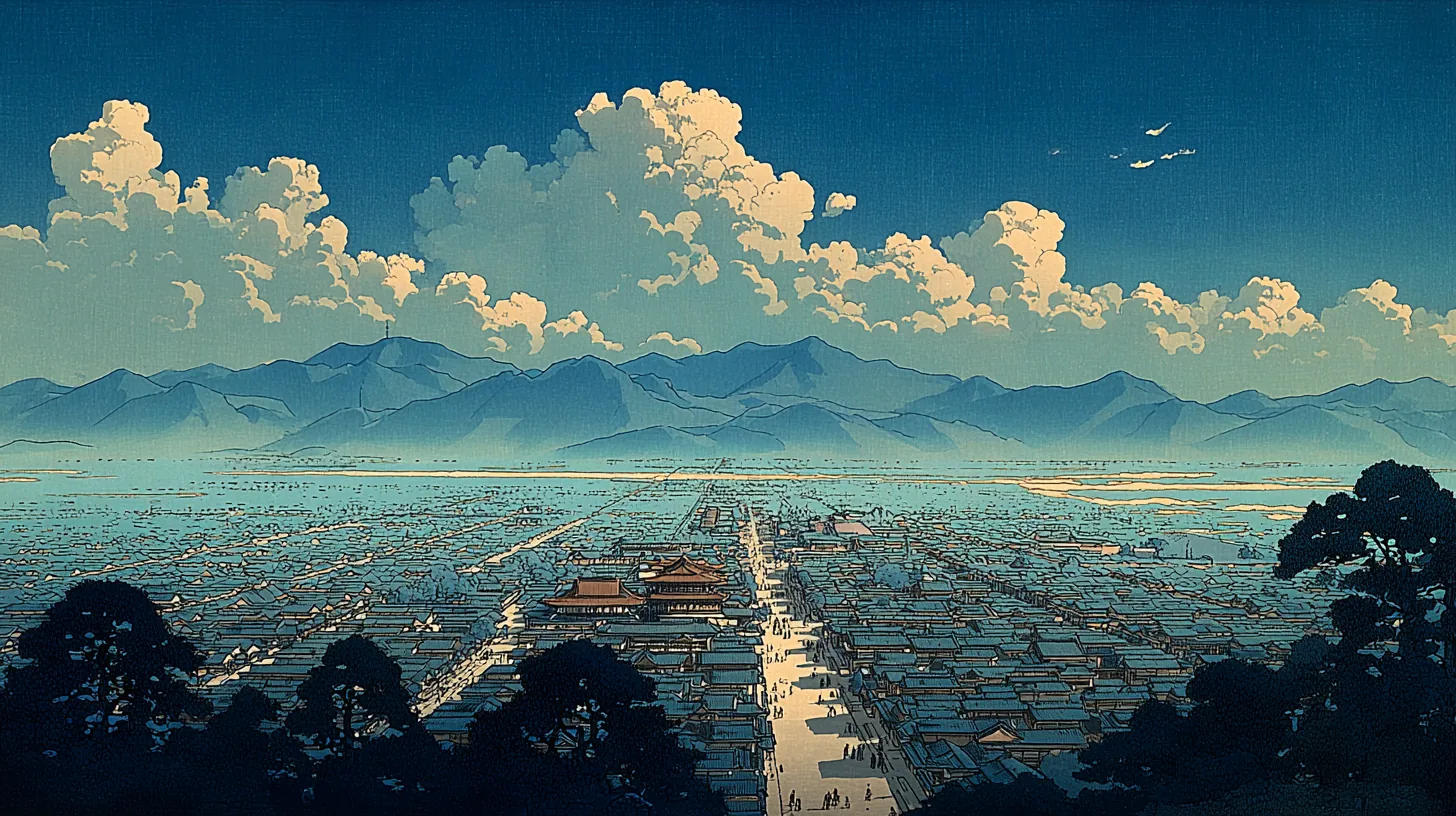
Engineers drove a massive central spine through the valley: Suzaku Ōji, an avenue 85 meters wide. This grand boulevard divided the population into two distinct administrative zones: the Left Capital (Sakyō) to the east and the Right Capital (Ukyō) to the west. At the northern apex sat the Dairi—the imperial palace complex—positioning the Emperor to face south down the avenue, looking over his subjects like the polar star.
Nature, however, ignored the grid. The western half of the city (Ukyō) sat directly on low-lying wetlands fed by river seepage. Within decades, malaria, structural rot, and standing water forced residents to abandon the western grid entirely. The entire population migrated east toward the drier, elevated ground near the Kamo River, permanently breaking the city’s symmetry and shifting the commercial gravity to the east, where Kyoto’s modern downtown remains anchored today.
The Capital That Kept Burning
To build in early Japan was to invite combustion. While European capitals relied heavily on quarry stone, Kyoto’s architectural lexicon was strictly wooden—specifically Japanese cypress (hinoki) and cedar, bound by clay mud walls and topped with thatch or bark tiles.
Fires were structural inevitabilities. Between the ninth and fifteenth centuries, the Dairi burned to the ground more than a dozen times, forcing the court to regularly camp out in the villas of wealthy aristocrats. Contemporary diaries treat urban conflagrations with the casual detachment modern citizens reserve for severe rainstorms; a thermal front could wipe out forty blocks in a single afternoon, only for carpentry guilds to begin re-erecting the exact same timber frames forty-eight hours later.
But structural accidents paled before the deliberate arson of the late fifteenth century.
The Ōnin War: When the Capital Destroyed Itself
In 1467, a succession dispute within the Ashikaga shōgunate—the military regime that theoretically ruled Japan from Kyoto’s Muromachi district—shattered the country into a century of anarchy. The opening salvo, the Ōnin War, converted the imperial capital into a ten-year slaughterhouse. Two regional warlord coalitions, packing over 80,000 samurai into the urban core, dug trenches across major avenues and fought house-by-house, utilizing primitive explosives and fire arrows.
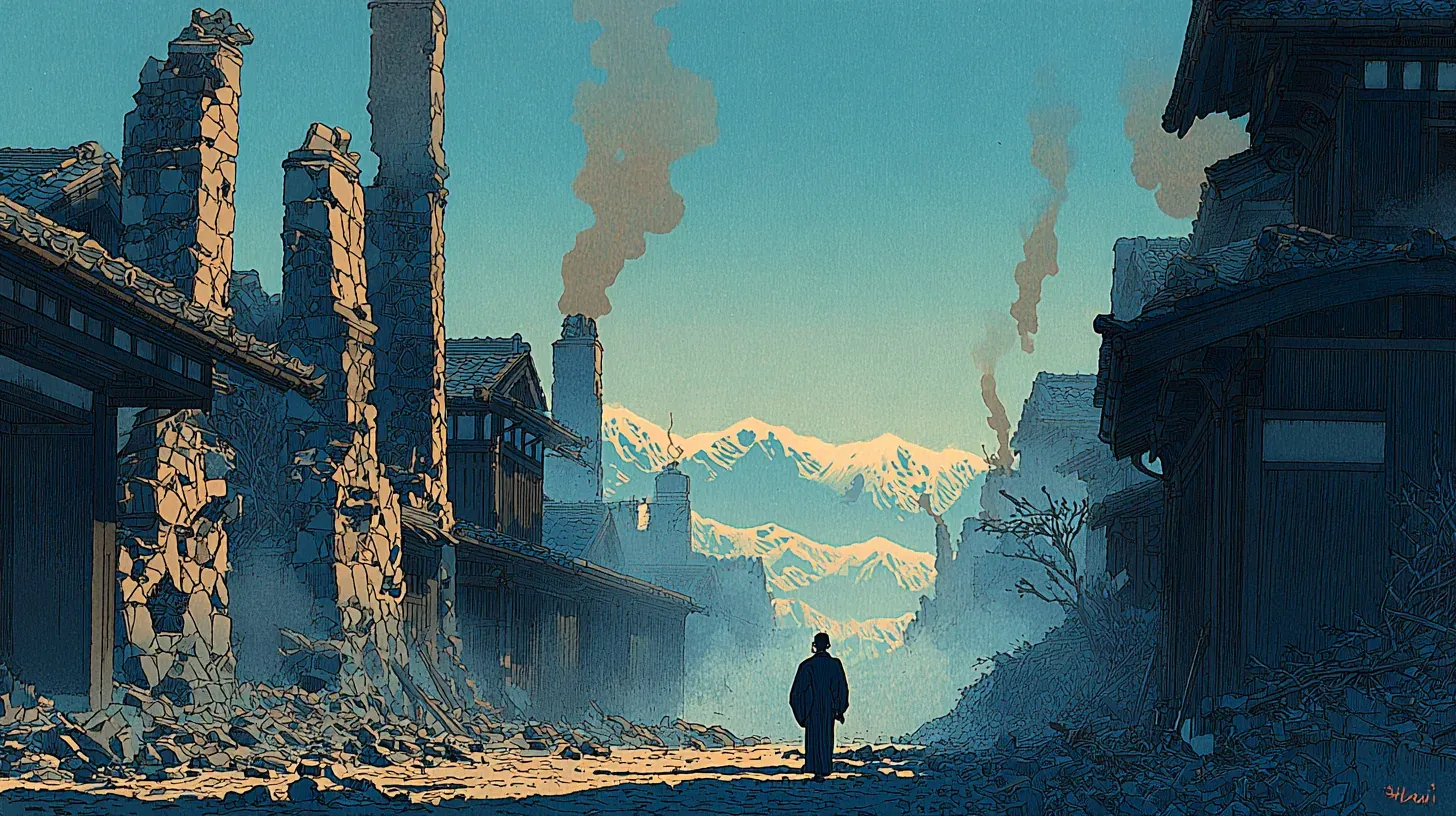
The northern sector, Kamigyō, became a wasteland. Ashikaga palaces, aristocratic libraries containing centuries of irreplaceable court diaries, and ancient temples vanished into smoke. The physical devastation killed the classical Heian court lifestyle; noblemen who had spent their lives orchestrating hyper-refined perfume-blending competitions and poetry tournaments suddenly found themselves foraging for wild greens in the ashes of their estates or fleeing to provincial ports for survival.
By 1477, the warriors moved their armies to the countryside, leaving behind a scarred valley where the population had dropped by half and crows nested in the charred pillars of the imperial palace.
The Townspeople Who Rebuilt a Capital
With the emperor impoverished and the shōgun politically castrated, Kyoto possessed no central government to fund its resurrection. Survival fell entirely to the machishū—a rising class of urban commoners comprising sake brewers, textile manufacturers, moneylenders, and elite artisans who inhabited the southern commercial sector, Shimogyō.
Rather than waiting for aristocratic patronage, these merchants organized deep autonomous networks. They grouped individual neighborhoods into chō—self-governing units bound by written legal codes, collective security pacts, and mutual fire-fighting duties. To survive the roaming brigands of the era, the machishū erected massive timber gates at every street intersection, dug defensive deep ditches around their wards, and funded private night watches.
The self-governance was layered:
- Individual households grouped into a chō (neighborhood unit).
- Multiple chō assembled into a chōgumi (district federation).
- The chōgumi council directed citywide finance, defense, and culture.
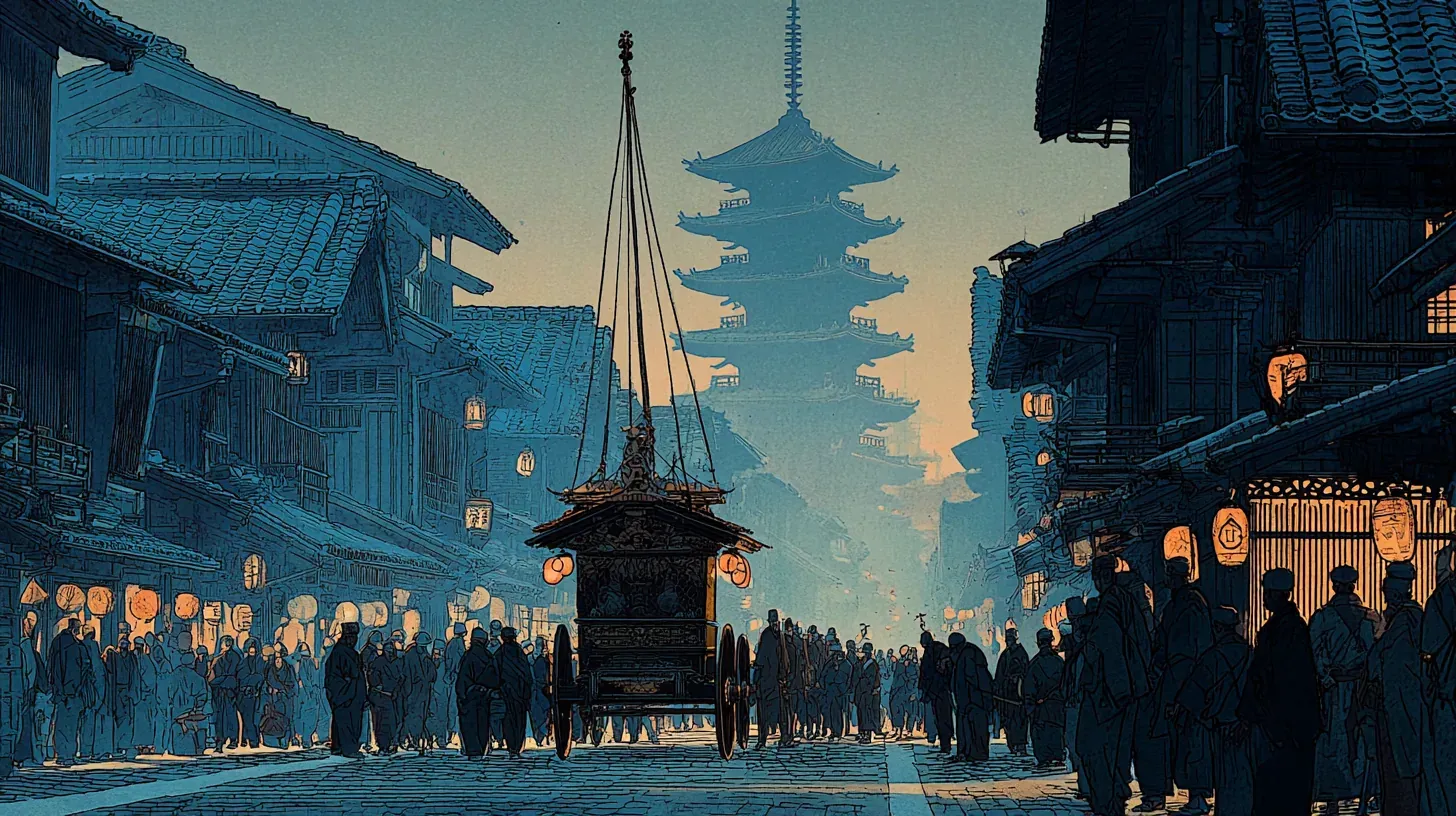
Their crowning act of defiance was cultural. In 1500, despite the ongoing regional instability, the machishū unilaterally revived the Gion Festival, which had been suspended for over three decades due to the war. They didn’t seek imperial permission; they simply pooled their commercial capital to rebuild the massive festival floats, transforming a religious ritual into a raw display of merchant wealth and resilience.
When European Jesuit missionaries like Luis Frois entered Kyoto in the mid-sixteenth century, they did not find a subservient population serving a divine king. They described a bustling merchant republic of 300,000 citizens that managed its own tax collection, maintained its own courts, and defended its borders with sophisticated militia systems—decades before the merchant classes of London or Amsterdam achieved comparable municipal autonomy.
Capital Without Power
How did an unfortified city retain its status as the nominal capital for centuries after it lost all control over the country’s tax revenues and armies?
The answer lies in the systemic Japanese separation of cosmic legitimacy from physical violence.
| Authority type | Holder | Location | Period |
|---|---|---|---|
| Ceremonial (coronations, religious rites, the symbolic state) | Emperor | Kyoto | 794–1868 |
| Military (rule by sword and rice tax) | Shōgun (Minamoto / Hōjō) | Kamakura | 1185–1333 |
| Military | Shōgun (Ashikaga) | Kyoto | 1336–1573 |
| Military | Shōgun (Tokugawa) | Edo | 1603–1868 |
When Minamoto no Yoritomo consolidated his grip over the samurai class in 1185, he deliberately established his administrative military base in Kamakura, over 400 kilometers away from the capital. He left the emperor in Kyoto. This dual-state model meant the shōgun wielded the swords and collected the rice taxes, but his political legitimacy derived entirely from a title granted by the imperial court.
Even when the Tokugawa shōgunate relocated the military administration to Edo (modern Tokyo) in 1603, they did not abolish Kyoto’s status. Instead, they built Nijō Castle right inside the city—not to house the emperor, but to spy on him. The shōgun paid for the court’s upkeep, but kept them under strict house arrest, banning them from participating in politics and forcing them to focus entirely on preserving ancient calendars, poetry styles, and Shinto purification rituals. Kyoto survived because it was a sacred museum piece; to destroy it was to destroy the spiritual title deed to Japan itself.
The War That Almost Ended Everything
That museum piece nearly dissolved into radioactive glass in the summer of 1945.
As the United States Target Committee finalized its short list for the deployment of the first atomic bombs, Kyoto sat at the very top. General Leslie Groves, head of the Manhattan Project, championed the city as an ideal target. It was an intellectual center, its mountain-ringed topography would concentrate the weapon’s blast radius for maximum destructive data, and its million-plus population had never experienced a major air raid, meaning the psychological trauma of its total erasure would break Japan’s remaining will to fight.
The decision chain that saved Kyoto:
- Target Committee goal — maximum psychological impact via urban destruction.
- General Leslie Groves — Kyoto is ideal; its pristine geography maximizes blast data.
- Secretary Henry Stimson — intervenes; warns destruction guarantees perpetual postwar hatred.
- President Harry Truman — approves the removal; Hiroshima is substituted.
Henry Stimson, the American Secretary of War, intervened directly with President Harry Truman. Stimson had vacationed in Kyoto during the 1920s, exploring its ancient temples and Zen gardens. His opposition, however, was rooted in realpolitik rather than mere sentimentalism. He argued that vaporizing Japan’s cultural heart would cultivate an unquenchable, multi-generational hatred among the civilian population, rendering any postwar American occupation impossible and driving a bitter, vengeful Japan directly into the arms of the Soviet Union.
Truman agreed with Stimson’s geopolitical assessment. Kyoto was scratched from the target sheet; Hiroshima took its place.
The Move That Wasn’t a Move
The collapse of the Tokugawa shōgunate during the Meiji Restoration of 1868 triggered a geographic identity crisis. The new, young reformers who seized power in the Emperor’s name needed to build a modern industrial nation-state. They looked at Kyoto—entrenched in tradition, physically isolated by mountains, and dominated by conservative religious institutions—and decided it could not serve as the engine of modern capitalism.
They needed Edo, the sprawling coastal nerve center of the old shōgunate, with its deep-water port and vast ready-made administrative quarters.
In 1869, the teenage Emperor Meiji moved his court into the former Edo Castle, which was promptly renamed Tokyo: the “Eastern Capital.” The ministries, foreign embassies, and printing presses followed.
Yet, the state apparatus never executed a formal legal demotion of the old capital. The relocation was designated tento—the “establishment of an additional capital”—rather than sento, the “transfer of the capital.” No imperial edict exists stating that Kyoto surrendered its status.
| Term | Meaning | Used in 1869? |
|---|---|---|
| Sento | Transfer of the capital — one capital dies, another begins | No (deliberately avoided) |
| Tento | Establishment of an additional capital — the original remains legally open | Yes |
This legal ambiguity is why some constitutional scholars and generational Kyoto families insist that the city remains an official co-capital of Japan to this day—a thousand-year sovereign seat whose primary resident simply packed his bags for an extended business trip to the coast and never returned.
The Thousand-Year Echo
The physical layout of modern Kyoto is a direct monument to this stubborn longevity.
Walk through the central streets today, and you are stepping along the exact coordinate lines drawn by Emperor Kanmu’s surveyors in 794. The wooden structures of Kiyomizu-dera or the Imperial Palace are rarely original timber—they are products of constant, cyclical re-erection following fires—but the spatial points, the construction techniques, and the human continuity remain completely unsevered.
This continuity manifests every July 17th during the Gion Festival.
Thirty-three yamaboko—massive wooden festival towers weighing up to twelve tonnes and standing several stories tall—are hauled through asphalt streets by hundreds of men in traditional robes. The structures use no metal nails or bolts; they are bound together using complex hemp rope knots (nawa-garami) designed to flex when the massive wooden wheels are forced into ninety-degree turns over wet bamboo planks.
The neighborhood associations that build, guard, and navigate these towers are not paid reenactors. They are the direct descendants of the machishū merchants who rebuilt the city from its ashes in 1500. They use the same corporate lineages, guard the same street corners, and read from the same hand-inked ledger books. The modern city roars around them, but the wooden gears still lock, the hemp ropes still hold, and the medieval grid continues to dictate the rhythm of the street.
Continue Reading
- Kyoto Travel Guide — the practical hub article on visiting Kyoto.
- Fushimi Inari Shrine: 10,000 Gates — the shrine that has watched the city for 1,300 years.
- Kiyomizu-dera: The 13-Meter Wooden Stage — a temple older than the capital itself.
- Arashiyama: The Truth About the Bamboo Grove — the western district Heian aristocrats escaped to.
FAQ
Why was Kyoto the capital of Japan for so long?
Kyoto — originally called Heian-kyō — served as Japan’s imperial capital from 794 to 1868, a span of 1,074 years. Emperor Kanmu established the city to escape the political influence of powerful Buddhist monasteries in the former capital, Nara. The city endured because of a uniquely Japanese separation between ceremonial authority (held by the emperor in Kyoto) and military power (held by shōguns in Kamakura, then Edo). Even when real political power moved elsewhere, no ruler formally stripped Kyoto of its status as the imperial seat.
When did Kyoto stop being the capital?
In 1869, Emperor Meiji moved to Tokyo (the renamed Edo), making it the functioning capital of modern Japan. However, there was never a formal edict declaring that Kyoto ceased to be the capital. The term used was tento (“establishing a capital”) rather than sento (“moving the capital”), leaving a deliberate ambiguity that some scholars note has never been fully resolved.
Why did Kyoto stop being the capital?
Kyoto stopped functioning as Japan’s capital in 1868 because the new Meiji government — formed after the collapse of the Tokugawa shogunate — decided the country needed an entirely different kind of capital to build a modern industrial nation-state. Three factors drove the decision. First, Kyoto was geographically isolated by mountains, with no deep-water port for foreign trade and diplomacy. Second, the city was dominated by conservative Buddhist institutions and old aristocratic families that the reformers saw as obstacles to modernization. Third, the abandoned Edo Castle — now empty after the last shōgun’s peaceful surrender — already had the deep-water port, the administrative quarter, and the ready infrastructure needed to host foreign embassies, ministries, and a modern bureaucracy. The teenage Emperor Meiji moved into the former shōgun’s residence in 1869 and the city was renamed Tokyo (“Eastern Capital”). Crucially, the government called this tento (establishing an additional capital) rather than sento (relocating the capital), so no legal edict ever stripped Kyoto of its imperial status — which is why some Kyoto residents and constitutional scholars still consider their city a co-capital today.
Was Kyoto destroyed in World War II?
Kyoto was largely spared from Allied bombing during World War II. It was on the initial target list for the atomic bomb, but Secretary of War Henry Stimson successfully argued to President Truman that destroying Kyoto’s irreplaceable cultural heritage would make postwar reconciliation with Japan impossible. The city did experience five limited bombing raids in 1945, but its historic core survived intact — a rarity among major Japanese cities.
What was the Ōnin War and how did it affect Kyoto?
The Ōnin War (1467–1477) was a ten-year civil war fought inside Kyoto between rival coalitions of feudal lords. The conflict devastated much of the city, particularly the upper city (Kamigyō). After the war, the merchants and artisans of the lower city — known as the machishū — rebuilt Kyoto through a system of neighborhood self-governance, funding reconstruction, organizing defense, and reviving cultural institutions like the Gion Festival.
Sources
- Imperial City: Kyoto’s Millennium as Japan’s Capital — Nippon.com
- Former Capital: A History of Kyoto Since 1869 — Nippon.com
- Kyoto: History — Encyclopædia Britannica
- Heian-kyō — World History Encyclopedia
- Heian Period — World History Encyclopedia
- Saving Kyoto in World War II — Japan Experience