Life in Edo: The City That Beat London by Half a Million People (And Was Made Entirely of Wood)
- Sleepy Tales of Japan
- 9 min read
Around 1700, London and Paris anchored Western urban achievement with roughly 600,000 residents each. European maps left the opposite side of the planet entirely blank. Yet a coastal megacity there already contained over one million inhabitants. Edo — the settlement we now know as Tokyo — nearly doubled the population of London without relying on a single stone house, glass window, or horse-drawn carriage.
Its streets were unpaved. Its inhabitants relied on charcoal cooking fires, candle illumination, and the sea breeze to keep a million bodies tolerable. How this wooden giant survived, functioned, and produced a hyper-literate consumer culture remains one of the most underrated stories in urban history.
Table of Contents
Open Table of Contents
A City of Fire and Reinvention
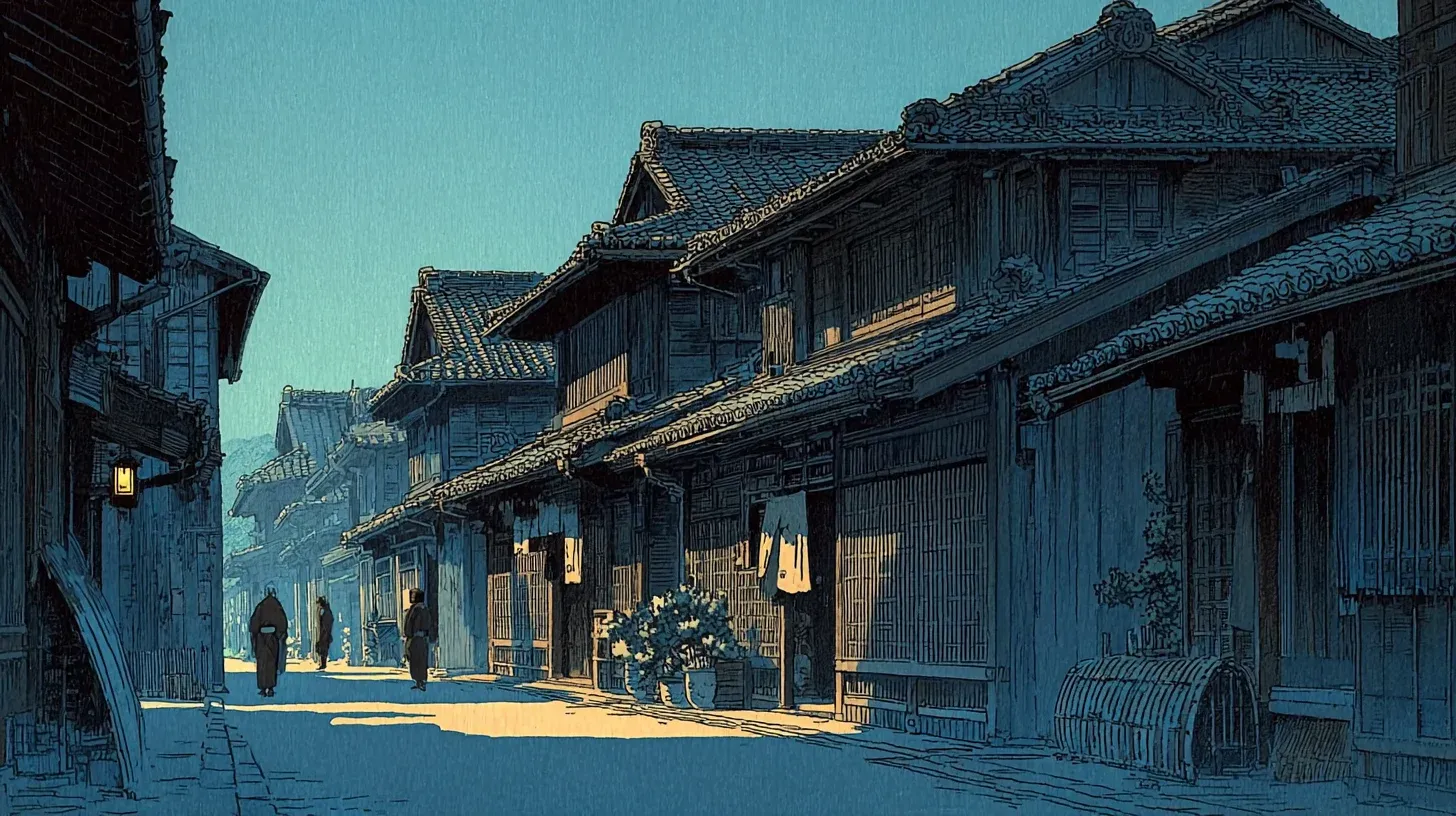
Edo was architectural tinder. Packed townhouses featured paper screens (shōji), thatched roofs, and open charcoal braziers (hibachi) for winter warmth. In a dense urban grid, fire was a mathematical certainty.
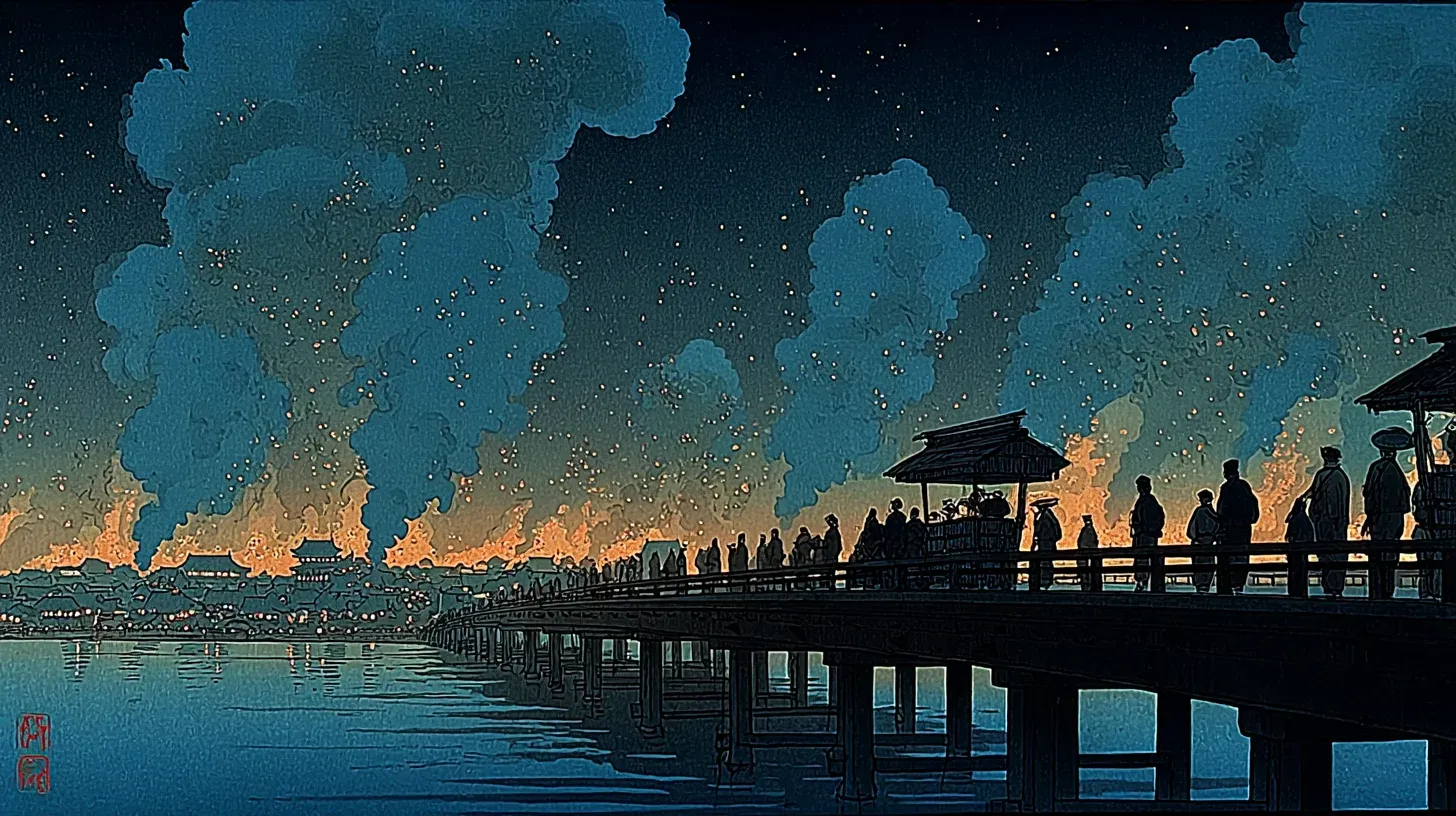
On March 2, 1657, the Meireki Fire broke out. Driven by hurricane-force winds, the flames consumed 60 to 70 percent of the city over three days. The fire claimed over 100,000 lives and destroyed more than 350 temples and 160 daimyō (feudal lord) mansions. Even the 40-meter-tall main keep of Edo Castle was reduced to ash.
The shogunate refused to rebuild the castle keep, dismissing it as a wasteful vanity project. Instead, military administrators executed a radical, top-down urban overhaul. They widened streets, cleared vast open-air firebreaks, and banished clustered temples to the city’s rural fringes to serve as emergency evacuation zones. New building codes mandated earthen walls and heavy tile roofing in commercial sectors.
Each rebuild left the city a little smarter.
Edo burned hundreds of times over the next two centuries, earning fires the grim moniker “the flowers of Edo” (Edo no hana). The pattern held: ash, then planning, then a denser and more resilient city than the one that burned.
The Economy of a Million
Sustaining a pre-industrial population of one million required a calculated system of political hostage-taking: sankin-kōtai (alternate attendance). Under this shogunal decree, every daimyō spent alternating years living in Edo, leaving their immediate families behind permanently as political collateral. Logistics and the maintenance of dual estates consumed the majority of a domain’s revenue, by some historians’ estimates — leaving little surplus to fund rebellion.
This enforced drainage of provincial wealth enriched the capital. Hundreds of lords, accompanied by thousands of samurai retainers, demanded premium sake, fine textiles, weapons, and massive stockpiles of rice. A permanent consumer economy followed.
Rice brokers, timber merchants, and money changers — officially the lowest tier of the Confucian caste system, the chōnin or townspeople — became the city’s de facto financial masters. At Nihonbashi, the bridge serving as the zero point for Japan’s five major highways, fish markets, publishing houses, and kimono empires thrived.
The samurai held the swords, but the chōnin held the ledgers.
The Floating World
Edo’s merchant class channeled their wealth into a distinct urban culture. They borrowed the Buddhist term ukiyo — originally meaning “the sorrowful, transient world” — stripped away its melancholy, and reshaped it into “the floating world.” The term came to signify the pursuit of immediate sensory pleasure, aesthetic refinement, and urban fashion.
Kabuki theater anchored this subculture. Emerging from regional roots, kabuki matured during the Genroku era of the late 1600s into avant-garde spectacle. Long before Western theaters adopted similar mechanics, Edo’s stages used revolving platforms and the hanamichi — a raised runway cutting straight through the audience to dissolve the boundary between performer and patron.
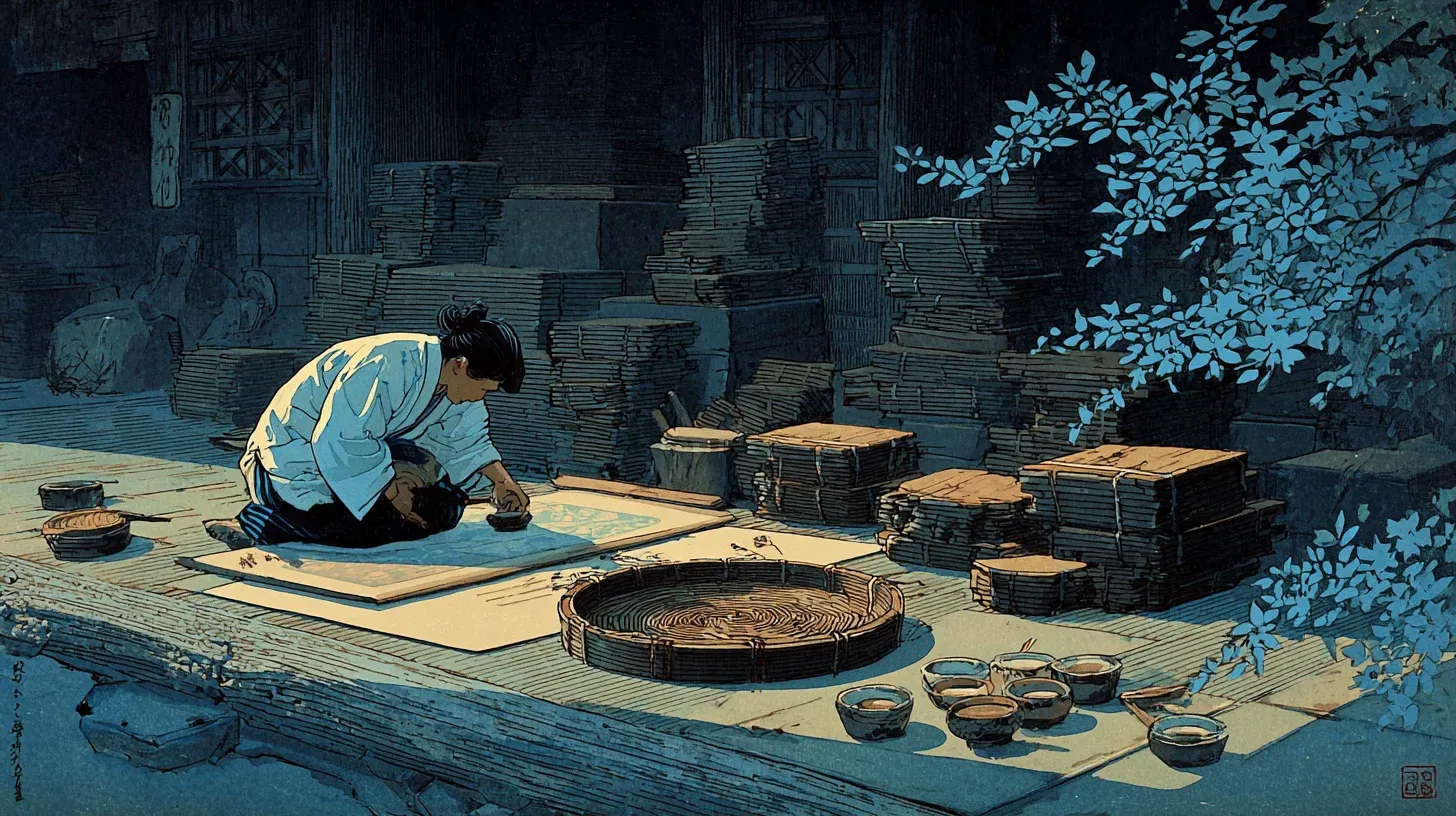
Mass-produced art democratized visual culture through nishiki-e (brocade prints). Woodblock carvers chiselled intricate designs into cherry wood, and printers layered ten or more colored inks onto handmade paper. These prints captured kabuki stars, courtesans, and sweeping landscapes. A single full-color print retailed for roughly 16 mon — identical to the price of a standard bowl of buckwheat noodles. Art was no longer the exclusive domain of aristocrats; it was an affordable item bought alongside lunch.
The literary avant-garde embedded themselves in the ordinary. The haiku master Matsuo Bashō observed this shifting landscape from his hut on the outskirts of Edo. His verses bypassed grandiose court themes, focusing instead on the splash of a frog entering an old pond — a stark insistence that profound art lived within mundane spaces.
A Bowl of Soba, a Woodblock Print
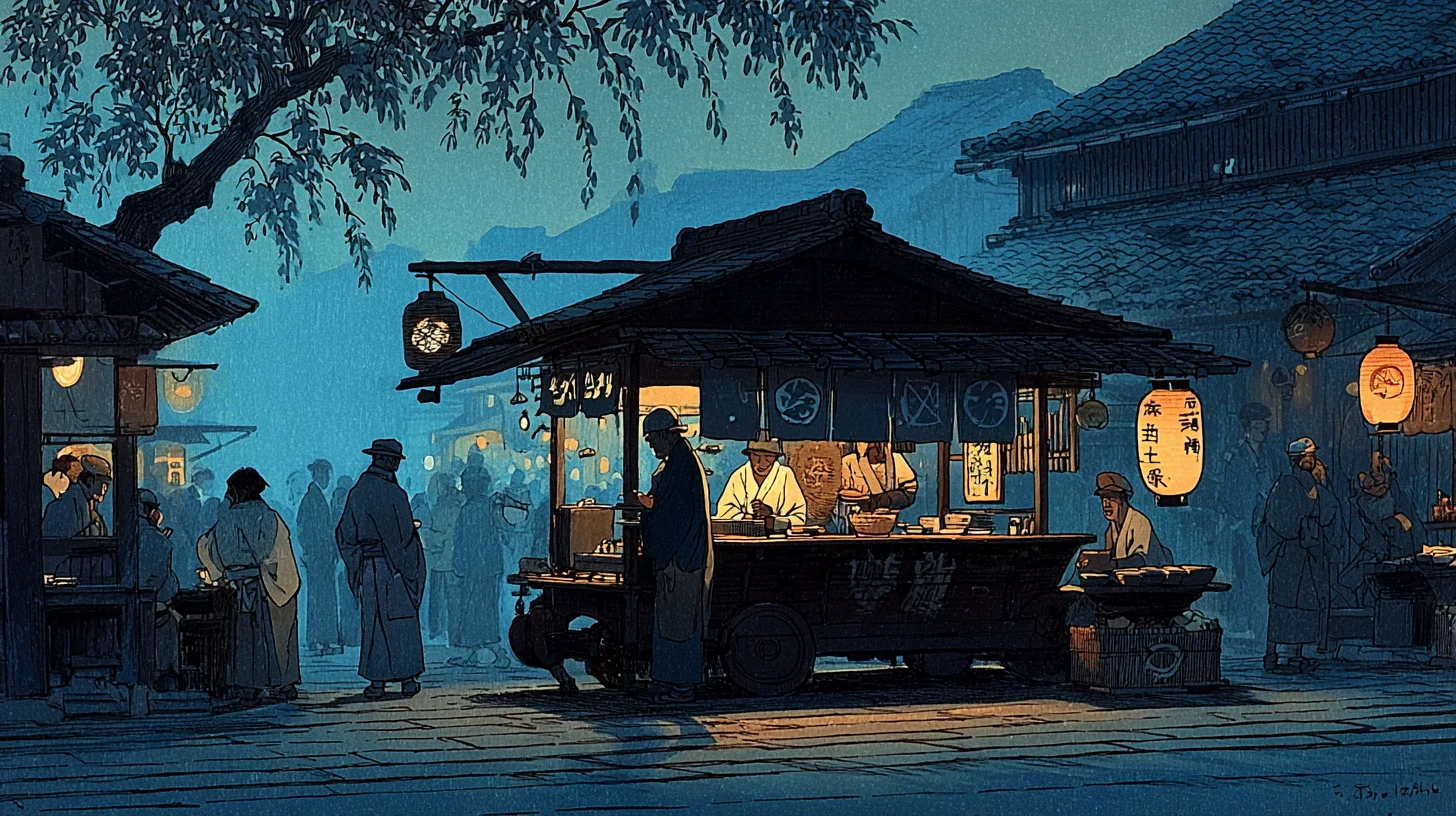
Edo’s true cultural engine operated on the street level. The city relied on yatai — mobile, wooden food stalls that deployed along busy canals and bridges. The eating-out phenomenon spiked after the 1657 Meireki Fire, when thousands of displaced residents required immediate, cheap sustenance.
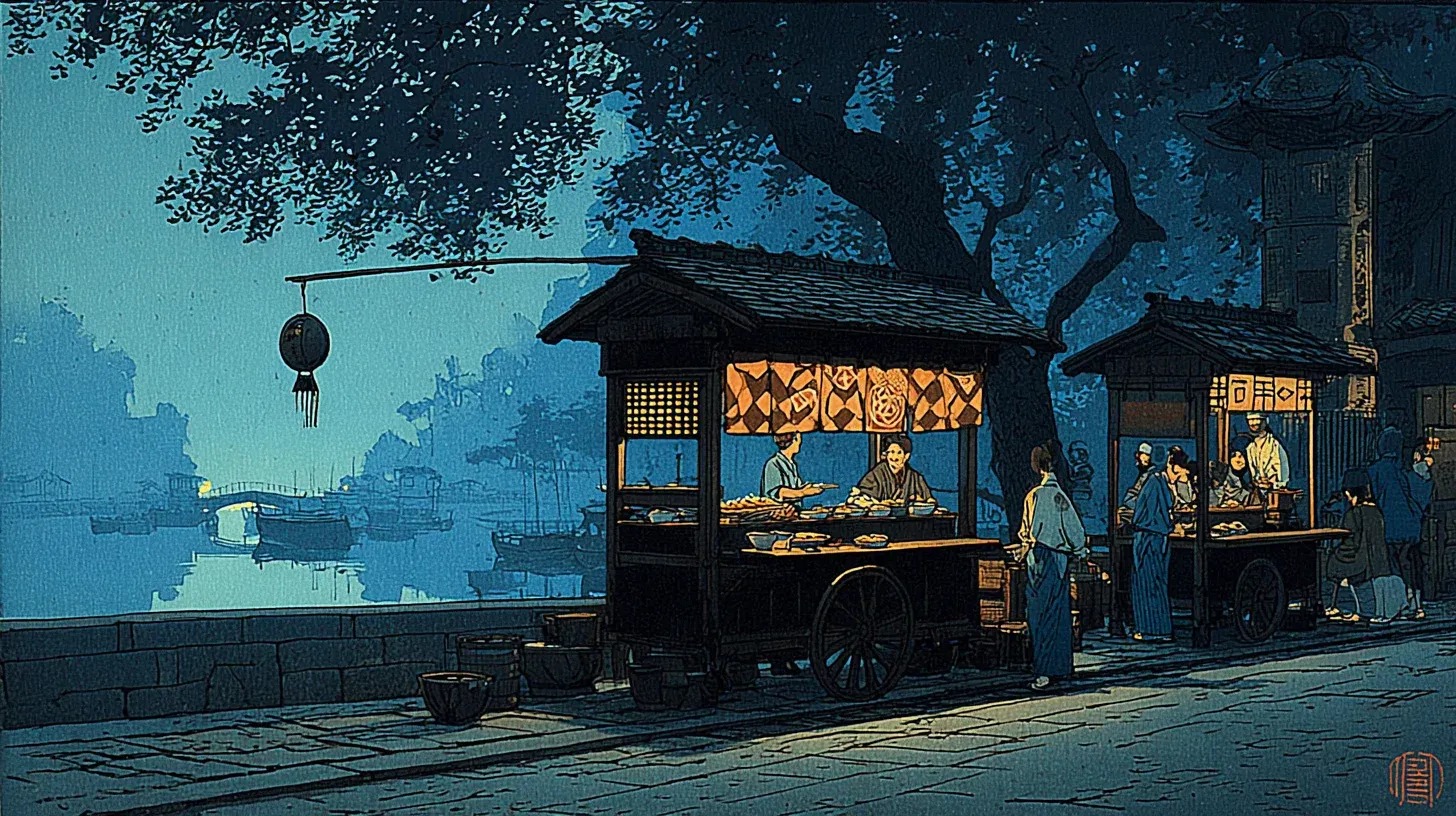
Street vendors invented what we now call Japanese fast food. Soba (buckwheat noodles) offered quick fuel for laborers and late-night samurai. Tempura, adapted from Portuguese deep-frying techniques, became cheap as vegetable oil production scaled mid-century. Vendors skewered local seafood, fried it in light batter, and served it piping hot. By the late Edo period, an entrepreneur named Hanaya Yohei popularized nigiri-zushi in the Ryōgoku district — hand-pressing vinegared rice topped with raw catch fresh from Edo Bay.
Fast food was born here.
Hygiene and socialization merged at the sentō (communal bathhouse). Since fires made private baths a high-risk liability for commoners, hundreds of public bathhouses operated daily from the 1590s onward. Class distinctions dissolved in steam as neighbors bartered gossip and news.
This social fluidity rested on an uncommonly literate populace. Historians estimate that 70 to 80 percent of Edo’s commoners possessed reading comprehension — surpassing literacy figures for contemporary London and Paris. Over a thousand neighborhood schools, known as terakoya (temple schools), trained children in basic literacy and commerce. A network of commercial lending libraries (kashihon’ya) circulated woodblock-printed novels, satirical pamphlets, and travel logs directly to households, making information widely accessible.
The Closed Country That Opened Inward
From the 1630s, the Tokugawa regime enforced sakoku (the closed country policy) to insulate its rule from external destabilization. The state banned foreign travel in 1633, expelled Portuguese merchants by 1639, and by 1641, restricted European trade entirely to Dejima — a small artificial island in Nagasaki harbor under strict surveillance.
Yet sakoku was never an absolute seal. Chinese merchants maintained quarters in Nagasaki; diplomatic missions arrived from Korea via the Tsushima domain. Maritime trade ran south through the Ryūkyū Kingdom (Okinawa) and north via the Ainu networks in Matsumae.
Cut off from foreign wars and colonial entanglements, Japan turned its creative energies inward. Over 250 years of uninterrupted peace allowed disciplines like ceramics, lacquerwork, textile dyeing, and landscape design to deepen across generations of master and apprentice. Isolation did not stunt development. It forced refinement.
What Edo Left Behind
Modern Tokyo still carries Edo’s blueprint, almost unedited. The high-end sushi counters of Ginza serve direct descendants of the quick vinegared rice Hanaya Yohei handed to workers in Ryōgoku. The sentō remains a functional neighborhood sanctuary. The woodblock lending libraries have evolved into a reading culture that keeps Tokyo among the world’s most literate cities.
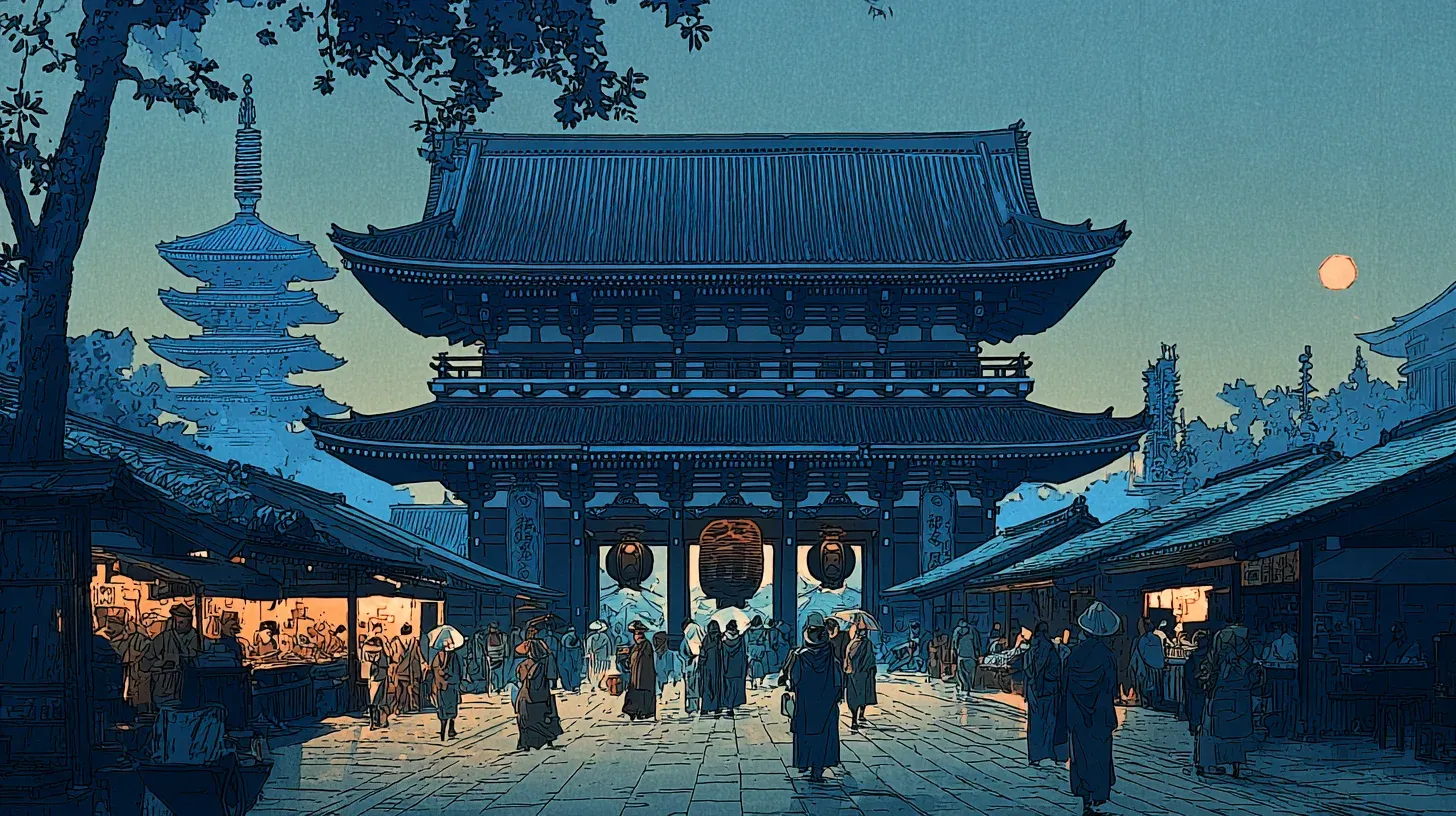
Walk down Nakamise-dōri in Asakusa. Smartphone cameras have replaced pilgrim staff tokens, but the commercial friction of browsing, snacking, and moving through sacred spaces is identical to its seventeenth-century iteration. The open parks, broad avenues, and even the paths of the metropolitan expressways exist because Edo’s planners carved out firebreaks after 1657. The habit of rebuilding — treating catastrophe as a chance to grow back smarter — carried Tokyo through the destruction of 1923 and 1945.
In 1700, Western eyes viewed London and Paris as the definitive centers of civilization. Edo was a parallel world they had no name for — a city of a million people who fed themselves from street stalls, educated their children in temple schools, and bought art for the price of a bowl of noodles. Three centuries later, the daily habits they invented still set the rhythm of the largest metropolis on Earth.
Continue Reading
- Tokyo Was a Swamp Nobody Wanted — how the city was built in the first place.
- Asakusa: Sensō-ji Was Founded in 628 — the corner of Tokyo that still feels like Edo.
- Japanese Food History — how Edo’s street vendors invented sushi.
- Is Mount Fuji Still an Active Volcano? — the 1707 eruption that covered Edo with ash.
FAQ
What was daily life like in Edo?
Daily life converged around communal infrastructure. Citizens frequented yatai (street food stalls) for quick meals, bathed in sentō (public bathhouses) to socialize, attended kabuki performances, and borrowed woodblock-printed literature from mobile libraries. A high urban literacy rate of 70 to 80 percent underpinned this vibrant street culture.
Was Edo really one of the largest cities in the world?
Yes. Driven by the sankin-kōtai system, which forced provincial lords to maintain large retinues within the capital, Edo’s population scaled dramatically. By the early 1700s, the population surpassed one million residents, making it significantly larger than contemporary London or Paris.
What is the “floating world” in Japanese culture?
Ukiyo, or the floating world, represents the distinct urban pleasure and artistic culture of Edo. Originally a Buddhist term emphasizing the transience of a sorrowful world, Edo’s middle class inverted its meaning to celebrate transient aesthetic joys, fueling the rise of kabuki, ukiyo-e woodblock prints, and popular literature.
How often did Edo burn?
Fires were a structural constant due to dense, all-wooden layouts. The Meireki Fire of 1657 stands as the most destructive, erasing roughly 60 to 70 percent of the city. Fires occurred with such frequency that locals dryly dubbed them “the flowers of Edo.”
What traces of Edo remain in modern Tokyo?
Edo’s street grid survives largely intact. The current Imperial Palace preserves early seventeenth-century moats and stone fortifications. Nihonbashi remains Japan’s highway zero point. Major expressways mirror filled-in canal lines, while the railway networks trace the original outer defense moats. For an immersive physical archive, the Edo-Tokyo Museum in Ryōgoku reopened in March 2026 after extensive multi-year renovations, displaying life-sized townhouses and master-print folios.
Sources
- Tokyo: History — Encyclopedia Britannica
- Sankin-kōtai — Encyclopedia Britannica
- Kabuki — Encyclopedia Britannica
- Sakoku — Encyclopedia Britannica
- Japan, 1600–1800 A.D. — The Metropolitan Museum of Art
- Meireki Fire — Edo-Tokyo Digital Museum
- Nishiki-e Defined — Hoover Institution, Stanford University
- Sento: History of Japan’s Bathhouse Culture — Nippon.com
- Terakoya: The Temple Schools of Edo-Period Japan — Nippon.com
- Edo-Tokyo Museum — Edo-Tokyo Museum (Official)